Croatian Souvenirs: What to Buy, from Lace to Licitar Hearts
A practical guide to Croatian souvenirs, from filigree jewellery and Pag lace to licitar hearts, Brač stone and lavender, plus packing and import tips.
On this page
Buy Croatian souvenirs for craft you cannot easily find elsewhere: silver filigree from Dubrovnik or Split, handmade Croatian lace, painted licitar hearts, small carved pieces of Brač stone and lavender from the Dalmatian islands. Skip anything that looks mass-produced and could sit in a souvenir shop in any Mediterranean town. This guide covers where each comes from and the practical side, from fragile stone to liquids in hand luggage.
Shopping fits naturally into a coastal itinerary, whether you are following the best places to visit in Croatia or adding a stop to a list of things to do. Most of these souvenirs are light, packable and sold in the towns you already pass through, so they rarely demand a detour.
What counts as a Croatian souvenir
Two categories matter. The first is craft with a regional identity: Croatian lace, filigree jewellery, licitar hearts, Brač stone and Konavle embroidery. The second is edible or drinkable produce, including Istrian olive oil, truffle products, arancini, Pag cheese and salt, and bottles of Plavac Mali or Pošip. The first group lasts; the second disappears into a suitcase within weeks, which is fine if you plan for it.
The items to treat cautiously are the ones with no regional link at all: generic ceramics, fridge magnets and printed T-shirts sold alongside genuine pieces. Their presence is not a scam, but paying handmade prices for them is a waste. A useful test is whether the shop can tell you where the piece was made and by whom.
Croatian lace: what a genuine handmade piece looks like
Croatian lace is the country's most distinctive textile souvenir, and Croatian lacemaking traditions are promoted as UNESCO-recognised heritage. Pieces include doilies, tablecloths and bookmarks, some worked from agave thread in a technique associated with the island of Pag, and sold in specialty stores in Dubrovnik.
What is the most bought souvenir in Croatia? Filigree jewellery, lace, lavender products, licitar hearts and Pag cheese and salt are among the categories most widely sold along the coast. Prices and ranges vary between towns, so compare a few shops before committing to a larger piece.
How can I tell handmade Croatian lace from machine-made lace? Look for small variations in tension, slight differences between motifs and soft, slightly irregular joins. Machine lace tends to be perfectly uniform, with repeated patterns that match exactly across several pieces on the same shelf.
Can I take Croatian olive oil and wine home in hand luggage? No. Bottles of oil and wine exceed the cabin liquid limits, so they need to go in checked baggage, wrapped and sealed against leaks.
Handmade lace has visible variation: slight differences in tension, tiny irregularities in the motif and a softness that machine lace lacks. Hold a piece to the light and look at the joins. If several examples on the shelf are identical down to the millimetre, you are looking at machine work, whatever the label says.
Pag is worth understanding as a single source of three souvenirs rather than one: lace, cheese and salt all come from the same island, and the trio makes a coherent set of gifts if you are island-hopping. You can read more about the coastline in our guide to the Croatian coast.
Licitar hearts: why they are keepsakes rather than sweets
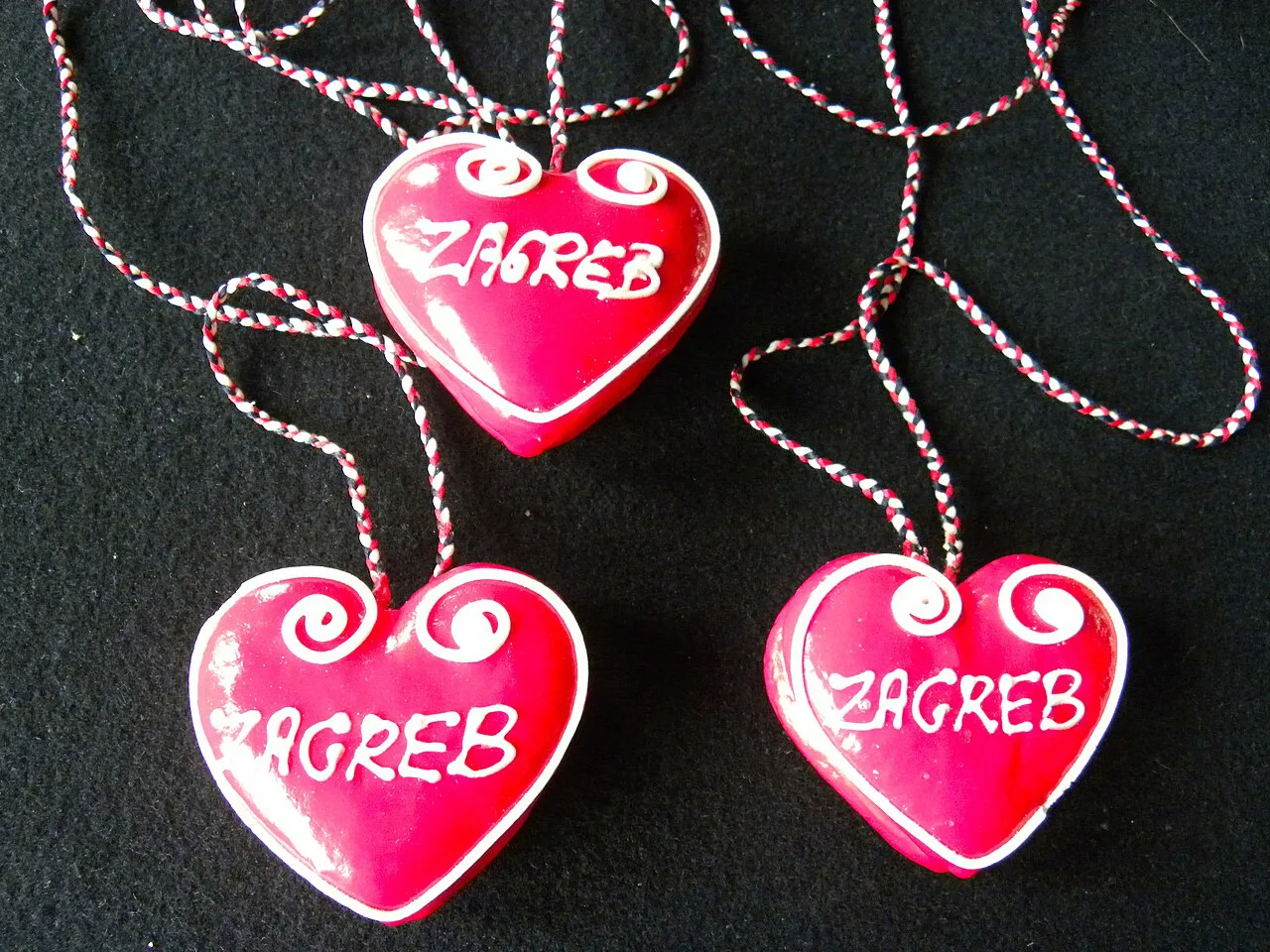
Licitar hearts are bright red, hand-decorated gingerbread shapes, traditionally given as tokens of affection and originating in the Zagreb region before spreading down the coast. They appear in gift shops throughout Dalmatia, usually displayed as ornaments rather than snacks. Buy one as a decoration, not as a treat to eat on the ferry.
Because they are stiffened and decorated for display, they survive a flight far better than most food souvenirs. Check that the icing and any attached ribbon are intact before paying, and ask for one wrapped in paper rather than loose in a bag. Small ones pack into hand luggage without difficulty.
Filigree jewellery: silver and gold wire work sold in Dubrovnik and Split
Croatian filigree is a centuries-old craft in which fine silver or gold wire is twisted into lace-like patterns for earrings, pendants and rings, often drawing on regional folklore motifs. In Dubrovnik you will find it in shops along and around the Stradun.
Look for shops that state the metal content and work with local metalsmiths, and ask whether the piece is handmade or cast. Cast copies of filigree patterns exist and are perfectly wearable, but they should not carry a handmade price. On earrings, check that the wirework is soldered rather than simply bent, since unsoldered pieces deform quickly.
Weight matters for travellers flying hand luggage only. Filigree is light by nature, which makes it one of the easiest souvenirs to carry, unlike stone or bottles. Keep the receipt separate from the piece if you want to declare or insure it.
Brač stone: small carved pieces and how to judge the finish
Brač is known for its pale limestone, quarried for centuries and used in buildings well beyond the island. As a souvenir it appears as small carved bowls, coasters, candle holders and relief plaques. The appeal is the material itself: dense, light-coloured stone with fine grain.
Judge the finish by running a finger over edges and the base. A well-finished piece is smooth and evenly worked, with no chipped corners or rough patches where the carver stopped. Lighter pieces are easier to carry home, and a small bowl or plaque wrapped in clothing will usually survive checked luggage; larger pieces deserve padded packing.
Lavender from Hvar and the Dalmatian islands: sachets, oils and bath salts
Lavender is associated with Hvar and the Dalmatian islands, where the plant has long been grown, and it reaches shops across the coast as sachets, essential oils, bath salts and even lavender chocolate. It is the easiest souvenir to pack: light, unbreakable and useful as a gift.
Sachets are the safest buy because they need no security checks and cannot leak. Oils and bath salts fall under the same liquid rules as any toiletries, so they belong in checked baggage or in containers of 100 ml or less if you are travelling with hand luggage only.
Olive oil, truffle products and arancini: edible souvenirs that survive the flight home
Istria produces olive oil and truffle products that travel well if packed properly, and gourmet shops in Dubrovnik sell bottled extra-virgin oil alongside truffle cheese, honey, pasta and salt. Arancini, strips of candied orange peel sometimes dipped in sugar or chocolate, are a Dalmatian sweet that packs into a small bag without fuss.
Bottles of oil belong in checked luggage, wrapped in clothing and sealed in a plastic bag, because the pressure change in a hold can still push oil past a cork. Truffle jars and honey travel more easily but count towards your weight allowance. If you are flying with cabin bags only, buy these at the end of the trip or choose smaller bottles.
Wine and rakija: Plavac Mali and Pošip bottles, and packing them in checked luggage
Dubrovnik sits near wine regions including Pelješac and Konavle, and wine shops sell Plavac Mali, a bold red, and Pošip, a crisp white, alongside rakija, the strong fruit brandy offered as a welcome in Croatian homes. Many wine shops will wrap bottles for safe travel, which is worth asking for.
Wine is heavy and fragile, so treat a bottle as a checked-luggage item only. Airline rules on alcohol in checked bags vary, and some carriers restrict how much you may bring, so confirm with your airline before you buy more than a bottle or two. Our Croatia travel guide covers getting around the coast if you are moving between islands with purchases in tow.
Pag cheese and Pag salt: buying the island's trio
Pag is known for a trio of products: cheese, salt and lace. The cheese is a hard, strongly flavoured sheep's cheese, and the salt comes from the island's coastal salt pans. Together with a lace piece, they make a set of gifts that all trace back to one place, which is more satisfying than a bag of unrelated trinkets.
Cheese is the awkward one. It needs to stay cool, and some countries restrict dairy imports, so check your home country's rules before buying a vacuum-packed wedge. Salt is the opposite: heavy but stable, sealed and unlikely to cause problems. Buy salt if you want certainty, cheese if you have a cool bag and a short journey home.
Game of Thrones merchandise: what it is and who it is for
Dubrovnik served as a filming location for Game of Thrones, and shops sell themed merchandise from hand-drawn maps to T-shirts and replica props. It is playful rather than traditional, and it is aimed squarely at fans who want a reminder that the city doubled as King's Landing.
If that is not you, spend the money elsewhere; the Old Town has plenty of craft worth the space in your bag. If it is, the maps and small props pack flat and avoid the sizing guesswork of a T-shirt. Either way, this is the category where prices vary most between shops, so compare before buying.
Three things to check before you pay: hand-made versus imported, certification, and packaging
First, ask where a piece was made and by whom. Shops that work with local craftspeople, including certified artisan outlets for filigree, can usually answer; vague replies suggest imported stock. Second, look for evidence of technique: slight irregularities in lace, soldered wirework in filigree and even finishing on stone.
Third, plan the journey home before you buy. Liquids go in checked bags, stone needs padding, wine needs a shop that will wrap it, and food may face import rules. Splitting purchases between a light craft item and one edible treat keeps weight manageable.
Which souvenir should you actually buy?
If you buy one thing, make it a piece of Croatian lace or filigree jewellery: light, handmade and tied to a specific place. Add a licitar heart as a cheap ornament, and choose Brač stone only if you have luggage space and patience for packing.
For edible gifts, lavender sachets and Pag salt are the low-risk picks, while olive oil and wine need checked baggage and a little planning. Good souvenirs come from towns you are already visiting; see our guide to the best towns in Croatia for where those stops fit.
Explore more Croatia guides
Frequently Asked Questions
What is the most bought souvenir in Croatia?
Filigree jewellery, lace, lavender products, licitar hearts and Pag cheese and salt are among the categories most widely sold along the coast. Prices and ranges vary between towns, so compare a few shops before committing to a larger piece.
How can I tell handmade Croatian lace from machine-made lace?
Look for small variations in tension, slight differences between motifs and soft, slightly irregular joins. Machine lace tends to be perfectly uniform, with repeated patterns that match exactly across several pieces on the same shelf.
Can I take Croatian olive oil and wine home in hand luggage?
No. Bottles of oil and wine exceed the cabin liquid limits, so they need to go in checked baggage, wrapped and sealed against leaks. Check your airline's rules on alcohol in checked bags before buying more than a bottle or two.
Sources
Notes from the Croatian coast
Optional updates when our guides change.
You might also like

Continue reading
More guides you'll find useful