Salona, Croatia: Visiting the Roman Ruins at Solin
Salona was the Roman capital of Dalmatia, now a ruin field at Solin near Split. What survives, how long the amphitheatre and basilicas need, and the trade-offs.
On this page
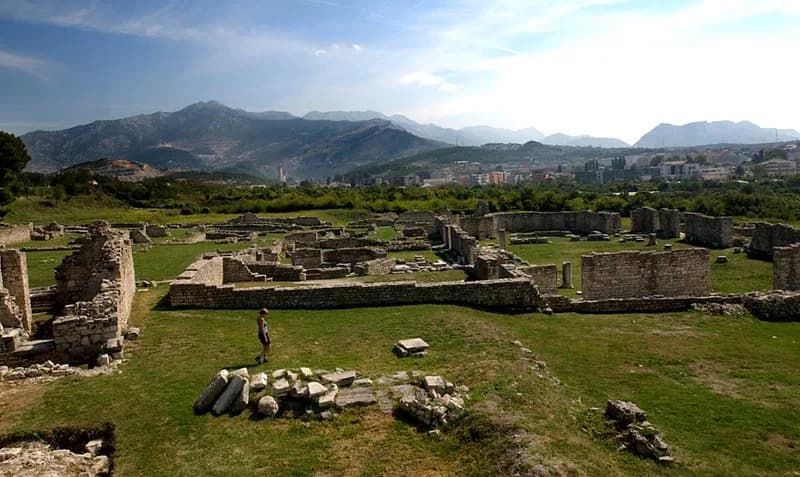
Salona is worth half a day, not a photo stop. The one-time Roman capital of Dalmatia now lies as a spread-out field of ruins at Solin, just inland from Split and below the Kozjak mountain, and its amphitheatre, gate towers, forum ground and early Christian basilicas reward anyone willing to walk between them. This guide covers what survives above ground, how the monuments are arranged, the story that connects the ruins to Diocletian's Palace, and the practical trade-offs of exposed ground in summer heat, on the Dalmatian Coast.
What Salona was
Salona began as a settlement of the Delmati, the Illyrian people whose name gave the region its later Roman title, Dalmatia. Rome took the site permanently in the first century BC, and the city's loyalty in the civil war between Caesar and Pompey was rewarded with colonial status and the provincial capital. From there it grew into a wealthy port and administrative centre beside the Jadro river, under the slopes of the Kozjak mountain.
At its height Salona was a proper metropolis, with a forum, theatre, baths and city walls, and it reached its peak under Diocletian, when it carried the honorary title Valeria. Estimates of its population vary between roughly 50,000 and 60,000, which placed it among the largest cities of the Roman Empire. That scale is why the ruins feel like a city rather than a single monument: you are walking through the footprint of an urban plan, not a villa.
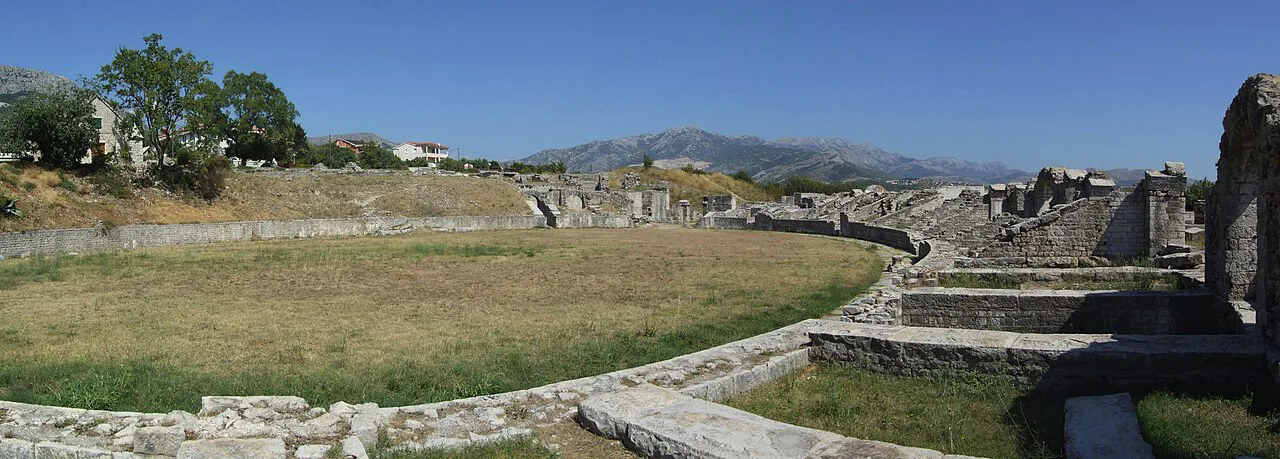
Where Salona sits and how it relates to Split
Salona is at present-day Solin, a town just inland from Split rather than a separate excursion into the interior, and the Jadro river runs through the modern town. The relationship with Split is the useful thing to hold on to: when Salona was abandoned in the early seventh century, its inhabitants moved to the defensible palace Diocletian had built for his retirement, and that settlement became Split. In other words, the ruins explain why the old town looks the way it does.
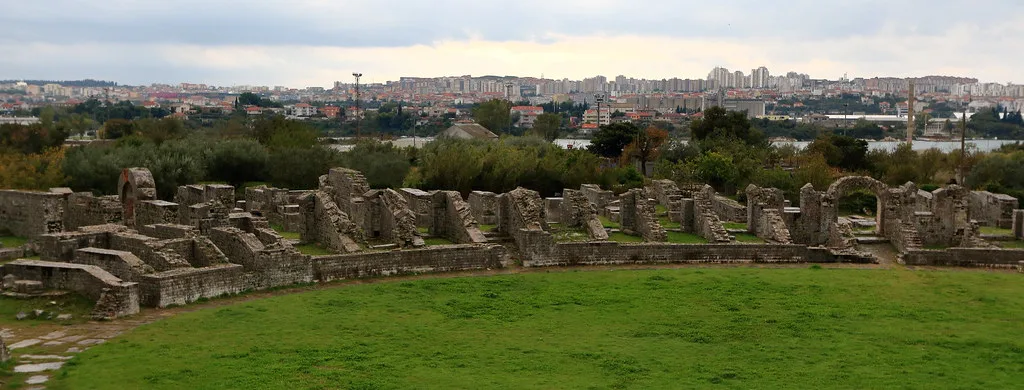
The amphitheatre
Start with the amphitheatre, the most legible structure on the site. It was built at the beginning of the second century and is one of only three such buildings the Romans raised on the eastern Adriatic coast, which makes it the regional counterpart to the arenas at Pula and elsewhere. Most of it stood on level ground, with the northern section cut into a natural hillside.
The auditorium was split into three tiers, the lower two with seats and the top reserved for standing spectators. Published capacity estimates for the amphitheatre run from roughly 15,500 to 17,000, so treat the figure as an order of magnitude rather than a precise count. Gladiator games continued here until the fifth century, and the structure was later quarried and deliberately damaged, notably by the Venetians in the seventeenth century to stop the Turks using it as a strongpoint. What you see now is substantial but broken rather than reconstructed.
City walls and gates
The eastern tract of the Augustan city walls survives in large stone blocks, with the Porta Caesarea gate flanked by octagonal towers still the clearest piece of Roman engineering on the site. The walls were extended in the second century under Marcus Aurelius to enclose all three sections of the city. Walk this stretch early, because the masonry and the gate plan give you the shape of the Roman street grid before the individual monuments blur together.
Forum, Capitol and the domestic city
The Forum lay in the south-eastern part of the city, with the Capitol as the centre of public, political and religious life, and the theatre, baths and necropolises clustered around it. Close by is the Villa Urbana, a wealthy townhouse known for mosaics showing Apollo, Orpheus and Triton. The mosaics are the reason to slow down in this quarter rather than stride across it.
Graves lined the roads out of the city, including the great necropolis along the route to Tragurium, modern Trogir, which produced some of the most famous sarcophagi at Solin. That road connection is worth noting for planning: Salona, Split and Trogir sit within a short stretch of coast, so the ruins work well as a stop on the way to the Trogir old town.
Early Christian Salona
Salona matters as much to early Christian archaeology as to Roman history. Between the fourth and sixth centuries it became an important Christian centre, with basilicas and large cemeteries containing martyrs' burials, and regional church councils were held there in 530 and 533. The Christian community had taken root in the third century under Bishop Venantius, who came from Rome and was martyred; his successor Domnius arrived from Syria.
That story ends badly and memorably. Diocletian, the last emperor to persecute Christians, had Domnius and his followers rounded up in 304 AD and executed in the amphitheatre itself, and a decade later Constantine's Edict of Milan granted religious tolerance across the empire. Reading the basilica foundations with that sequence in mind turns a field of low walls into a narrative.
How long to allow and how to move between the monuments
Budget about half a day on site. The monuments are dispersed across open ground rather than stacked together, so the time goes on walking between the amphitheatre, the walls, the forum area and the Christian basilicas, plus the reading that makes sense of low foundations. A rushed hour gets you the amphitheatre and little else.
Wear shoes that cope with uneven stone and gravel, and carry water, because shade between the monuments is scarce. Plan the order around the heat: the amphitheatre and the open necropolis ground first, the shaded or enclosed corners later. If you are combining Salona with the coast, the harbour towns south of Split make a natural second stop the following day.
When to go
Spring and early autumn suit Salona best. The site is largely exposed, with little cover over the forum ground and the amphitheatre cavea, so a midsummer midday visit is punishing and the walking between monuments slows to a shuffle. May, June, September and October give you the same ruins with tolerable heat and thinner groups.
Tickets and opening times
Ticket prices and opening hours for Salona change with the season and should be confirmed with the site before you travel rather than taken from an old blog post. Croatia has used the euro since 2023, so any kuna figure you see online is historic.
Getting there from Split without a car
Solin sits just inland from Split, close enough that the ruins can be fitted into a Split-based day; the practical constraint is the time spent on the ground once you arrive, not the distance. Traffic on the approach roads is heavy in summer, so allow slack if you are fitting the ruins into a day that ends with a ferry.
Allow for the monuments being spread across the Solin area rather than gathered behind one gate, so the visit is a walk between separate clusters rather than a single circuit.
Who Salona suits, and who should skip it
Salona is for travellers who enjoy Roman history and early Christian archaeology, and for repeat visitors to Split who have already done Diocletian's Palace and want the reason it exists. It rewards a little preparation: read about Domnius and the amphitheatre beforehand and the low walls start to speak.
Skip it if you want big, photogenic set pieces and have limited time in Dalmatia. The ruins are broken and dispersed, and children or companions expecting a reconstructed Arena will be disappointed. Pair it instead with a fortress-and-old-town day along the coast if that is more your register.
Salona or Diocletian's Palace first?
Do Salona first. Seeing the abandoned Roman capital before you walk into Diocletian's Palace makes the palace legible as a refuge rather than a standalone marvel, and half a day at Solin is enough to set up the rest of a Split trip.
Go in the shoulder months, start with the amphitheatre, and treat the basilicas as the intellectual heart of the visit. If you want to extend the Roman and medieval thread, add a day at Trogir and its old town nearby.
Explore more Dalmatia guides
Frequently Asked Questions
When was Salona founded?
Salona grew from an Illyrian Delmati settlement at the mouth of the Jadro river. It was permanently taken by Rome in the first century BC and later became a Roman colony and the capital of the province of Dalmatia.
Does Croatia have Roman ruins?
Yes. Salona at Solin is among the largest Roman archaeological sites in Croatia, with an amphitheatre, Augustan city walls and gates, a forum area and early Christian basilicas. Other Roman remains survive in Split itself, notably Diocletian's Palace.
What was Salona called in Roman times?
It was known as Colonia Martia Julia Salona after its colonial status, and under Diocletian it carried the honorary title Valeria. Today the ruins lie within the modern town of Solin.
Sources
Notes from the Croatian coast
Optional updates when our guides change.
You might also like
Continue reading
More guides you'll find useful