
Zadar City Walls: What to See and How Long to Allow

The stretch of Zadar city walls you can actually walk is the northeastern side of the peninsula, a broad, tree-edged path on sixteenth-century bastions looking down over the Old Town harbour. Entry to this section is free, and an hour is enough to walk it and take in the views. This guide covers where the walls sit, which gates to look for, how long to allow and what to see nearby once you come down.
Where the Zadar city walls are and which stretch you can walk
Zadar's Old Town occupies a compact peninsula, and the defensive walls wrap around its seaward edges. The section that works as a promenade is the one on the northeastern side, reached from several points off the Old Town streets. Treat it as a raised walk rather than a full circuit: the surviving stretches are discontinuous, so you join and leave the walls rather than looping the whole town on top of them.
The usual approach is on foot from the centre: pick up the walls near the harbour side of the peninsula, walk the length of the raised path and drop back into the streets at the far end. Because the entrances are scattered rather than signposted as a single trailhead, it pays to scan a map of the Old Town before you set off. The heavy stone gates described below make natural markers for where to start and finish.
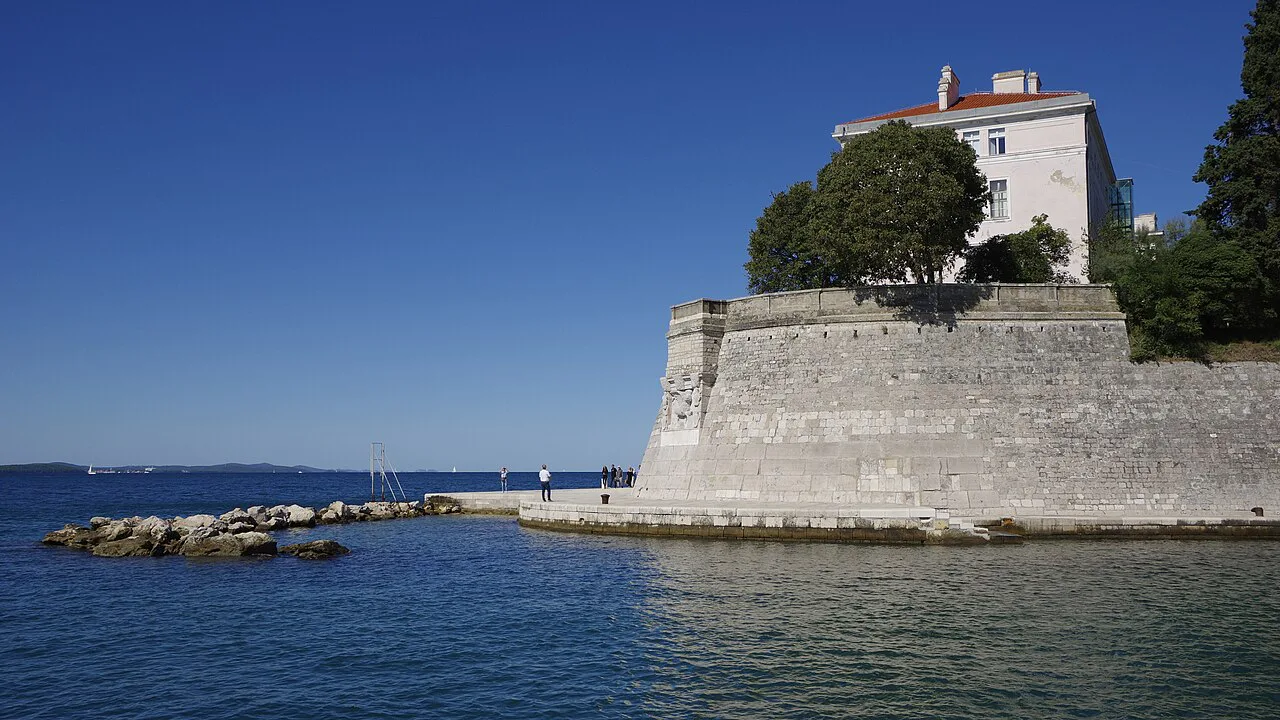

The northeastern walls above the Old Town harbour
The northeastern stretch is the longest surviving piece of the defensive system, and it reads as part history lesson and part elevated city park. A wide path runs along the top, edged with stretches of greenery, and the drop on the harbour side opens up views across the Old Town rooftops and the water. Access is from various points on the northeastern side of the Old Town, and entry is free.
The path is open and shadeless for long sections, so the walking itself is easy but the sun is not. Go early or late in the day in high summer, and carry water. Because the walls are raised, this is also the quickest way to understand the town's layout before you start threading through the lanes below.
For orientation, walk the walls first and the streets second. From the top you can pick out the harbour, the cluster of churches in the middle of the peninsula and the line of the gates, which makes everything afterwards easier to find.
Why the walls matter: Venetian defences and UNESCO protection
The fortifications on this side were built in the sixteenth century to keep the city safe from Ottoman attack, and they stand as a strong example of Venetian fortress architecture on the Dalmatian coast. Zadar's walls were placed under UNESCO protection in 2017.
That context is worth having in your head as you walk, because the walls are easy to treat as a viewpoint. Look for the massing of the bastions, the thickness of the parapets and the way the line follows the shape of the peninsula. The gates, covered next, are where the defensive thinking becomes most legible.
The Land Gate (Kopnena vrata)
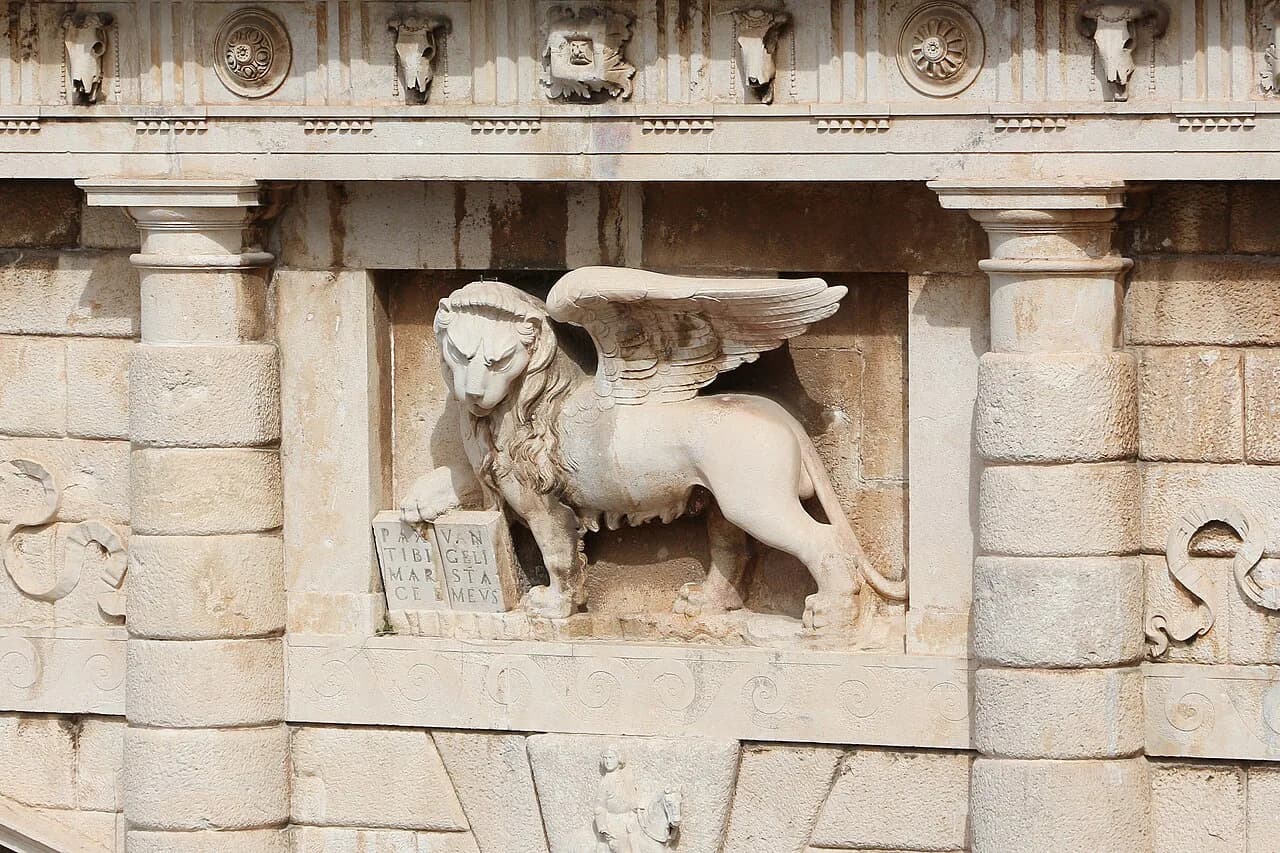
The Land Gate, Kopnena vrata in Croatian, is the most ornate of Zadar's wall entrances and the main historic way into the peninsula from inland. Michele Sanmicheli built it in 1543 in the form of a triumphal arch, with a central passage for wheeled traffic and two smaller side passages for pedestrians. It still counts among the finest Renaissance monuments in Dalmatia.
Look above the arch for the carving of a winged lion, the coat of arms of the Venetian Republic, alongside St Chrysogonus, Zadar's main patron saint.
The gate stands near the small Foša harbour on the inland edge of the Old Town, which makes it a sensible place to begin a walk that finishes on the northeastern walls. Step through the arch and you are already inside the peninsula, with the main sights within a few minutes on foot.
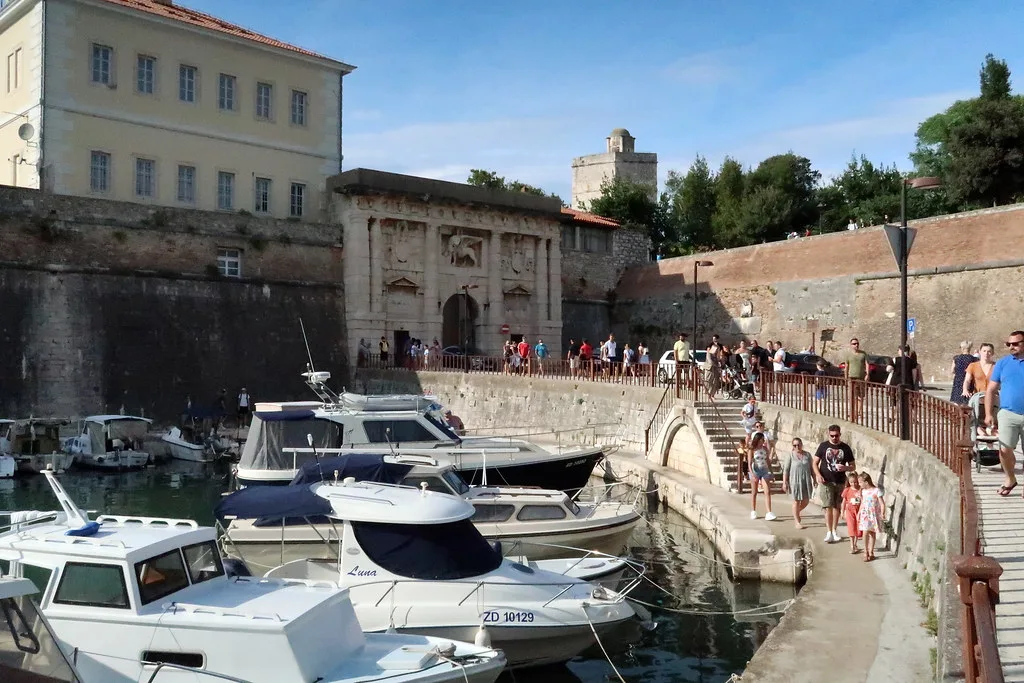
The Sea Gate and the Bridge Gate
The Land Gate is the grandest entrance but not the only one. The Sea Gate, Luka Vrata, also known as St Chrysogonus' Gate, stands close to the ferry port and was built in 1573, the year the Christian fleet defeated the Ottomans at Lepanto. The Bridge Gate sits by the bridge that carries you across to the Old Town.
In practice the three gates do different jobs for a visitor. Arriving from the bus station or the mainland side, the Land Gate or Bridge Gate is your way in; coming off a ferry or catamaran, the Sea Gate puts you straight into the Old Town. Pairing one gate as your entry with the northeastern walls as your exit gives a natural half-day shape without any backtracking.
Getting there on foot, and parking at Ravnice
On foot, everything here is close together. Come through the Land Gate from the Foša side, or cross by the Bridge Gate, and you are minutes from both the streets and the wall entrances. If you are driving, the Ravnice car park is the practical choice: park there, walk through Vladimir Nazor Park and you arrive at the Land Gate.
Ravnice is popular because it sits close to the Old Town and is described as low-cost even at the height of the season, and in this guide's view it is the obvious fallback if you are arriving by car for the day. Rates change, so read the tariff on the machine when you arrive rather than budgeting from an old figure.
How long to allow: a harbour stroll or a fuller loop
The short version is forty-five minutes to an hour: enter through the Land Gate, walk the northeastern walls end to end at an unhurried pace, and come down near the harbour. That is enough for the views, the greenery and a look at the bastions, and it fits easily around other plans.
The fuller version takes two to three hours and treats the walls as the frame for an Old Town loop. Walk the northeastern stretch, drop into the lanes, see the gates from both sides and finish at the waterfront. The trade-off is straightforward: the short walk is all about the fortifications and the view, while the longer one adds the town's churches and squares at the cost of more time on your feet.
Best time of day and season for walking the walls
The raised path is exposed, so in high summer aim for early morning or the last couple of hours of daylight rather than the middle of the day. In spring and autumn the exposure matters much less and the timing is more flexible.
The bura, the cold northeasterly wind, can make the exposed bastions bracing even on a bright day, so a light windproof layer is worth carrying out of season. Summer crowds in the Old Town thin out in the early morning, when the lanes and the gates are at their quietest.
Nearby after the walls: waterfront and Old Town sights
Come down from the northeastern walls and the waterfront is right there. The Sea Organ Zadar is set into the seafront steps and plays as the Adriatic Sea moves through its pipes, and the Greeting to the Sun light installation sits on the same promenade. Both are free, open-air and at their best around sunset.
Inland, the Roman forum Zadar is the civic heart of the peninsula, with the Church of St Donatus, Zadar rising beside it as the town's most distinctive early medieval building. The Cathedral of St Anastasia and Five Wells Square are within a few minutes' walk, so a single loop covers walls, gates and the main monuments without any transport.
If you want to slow the pace after the walls, the Museum of Ancient Glass, Muzej antičkog stakla, and the Archaeological Museum Zadar, Arheološki muzej Zadar, both sit in the Old Town and make good indoor stops when the sun or the bura gets the better of you. Opening hours vary through the year, so confirm them with each museum on the day.
For the wider picture of what else is worth your time in the city, Zadar Attractions: 13 Visitor Guides cover the rest of the peninsula's sights, from churches to museums, in a single place.
Is the walk along the Zadar city walls worth it?
Yes, if you treat it as a short, free walk with a view rather than a full circuit of the town. The northeastern bastions deliver the harbour panorama and a clear sense of the peninsula's shape in under an hour, and pairing them with the Land Gate gives the walk a proper start and an architectural highlight.
Skip it only if you are pressed for time and would rather spend the hour on the waterfront and the forum. Otherwise go early, take the short route on a hot day, and finish at the sea organ as the light drops.