
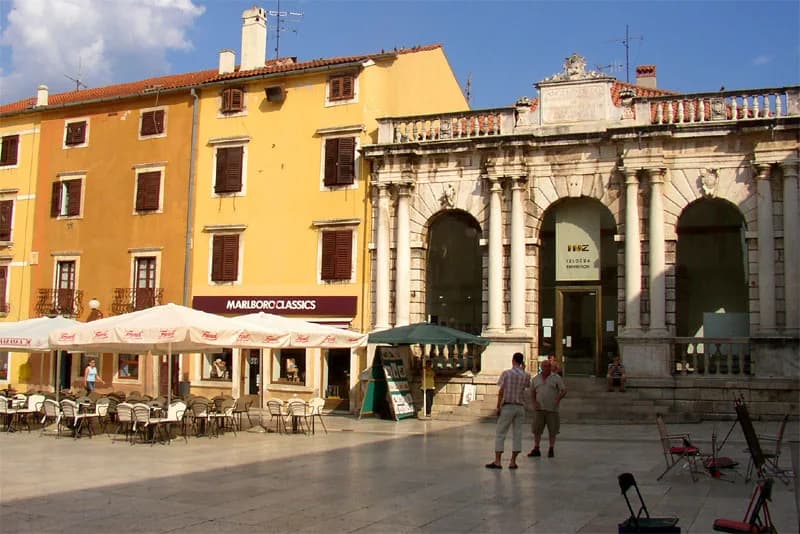
Narodni trg, Zadar: a visitor's guide to the People's Square

Narodni trg is the central square of Zadar's old town and has been the focus of public life there for the past five hundred years, so it is worth ten or fifteen minutes of anyone's morning. It is a free, open public space rather than a ticketed sight, and the pleasure lies in reading its four sides before you move on. This guide covers where the square sits on the peninsula, how to reach it on foot, what to look for and how to slot it between the Roman Forum and the squares further down Kalelarga.
Treat it as a pause, not a destination in itself. Zadar's old town compresses a great deal into a small peninsula, and Narodni trg works best as the midpoint of a walk rather than a place you set aside an afternoon for.
What Narodni trg is and why it matters
Narodni trg, the People's Square, is the square that has stood at the centre of Zadar's public life for roughly five centuries. It is not a monument behind glass: locals use it for coffee, for meeting friends and for the business of the day, which is exactly how it should be seen. Its Croatian name is worth knowing before you arrive.
The square has a Renaissance pedigree and is bordered by historic buildings, which is why it repays a slow lap rather than a quick photograph. Arrive knowing what is on each side and the space stops being a blur of stone and café chairs.
Where the square sits and how to reach it on foot
Narodni trg occupies the middle of Zadar's historic peninsula, a few minutes' walk south of the Roman Forum. The natural approach is along Kalelarga, the long straight street also known as Široka ulica, which runs through the old town as its spine. Start at the Roman forum and walk south; the square opens out in front of you before you have gone far.
Because everything on the peninsula is pedestrian, you will arrive on foot whatever your mode of transport to Zadar. Boats and buses drop visitors at the edges of the old town, and the last stretch is always walking. Wear shoes you can spend a morning in, since the paving is polished stone.
Reading the square: the north side and the City Guard clock
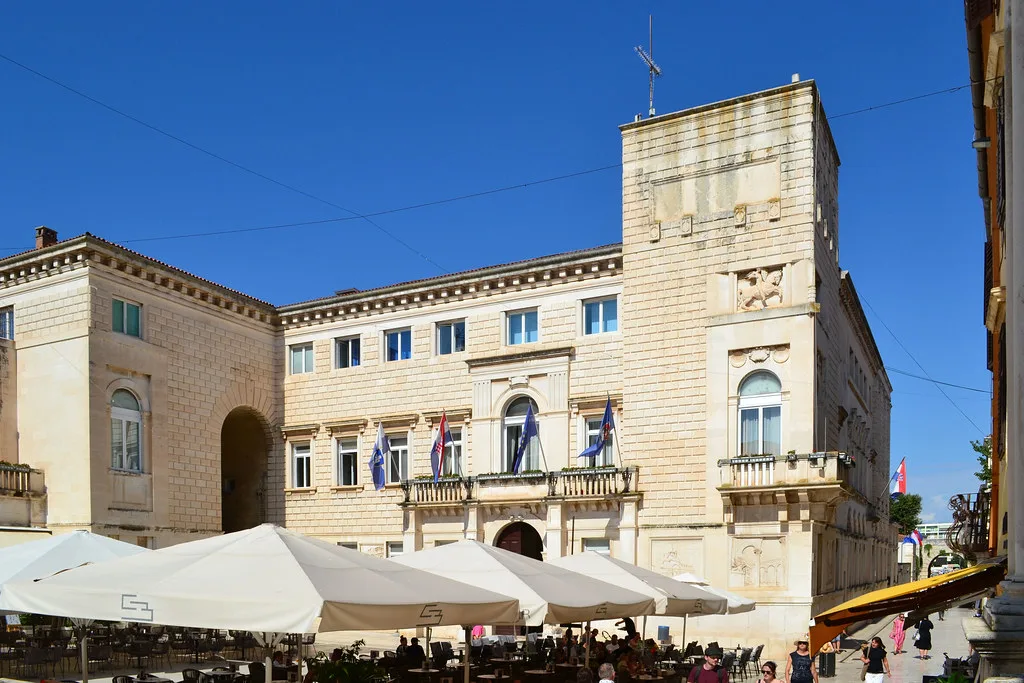
On the north side of Narodni trg stands the tower of the City Guard, built in the sixteenth century, and its clock face is the detail most visitors miss while looking at their phones. Look up: the tower gives the square its vertical marker and tells you which way you are facing on the peninsula. The clock is the square's oldest piece of street furniture still doing its original job.
Below the tower, the square's north edge functions as the everyday face of the city: a shaded place to sit and watch the passing trade. Pause here rather than pushing straight through to the southern end.
The east side, the City Lodge and the lamp
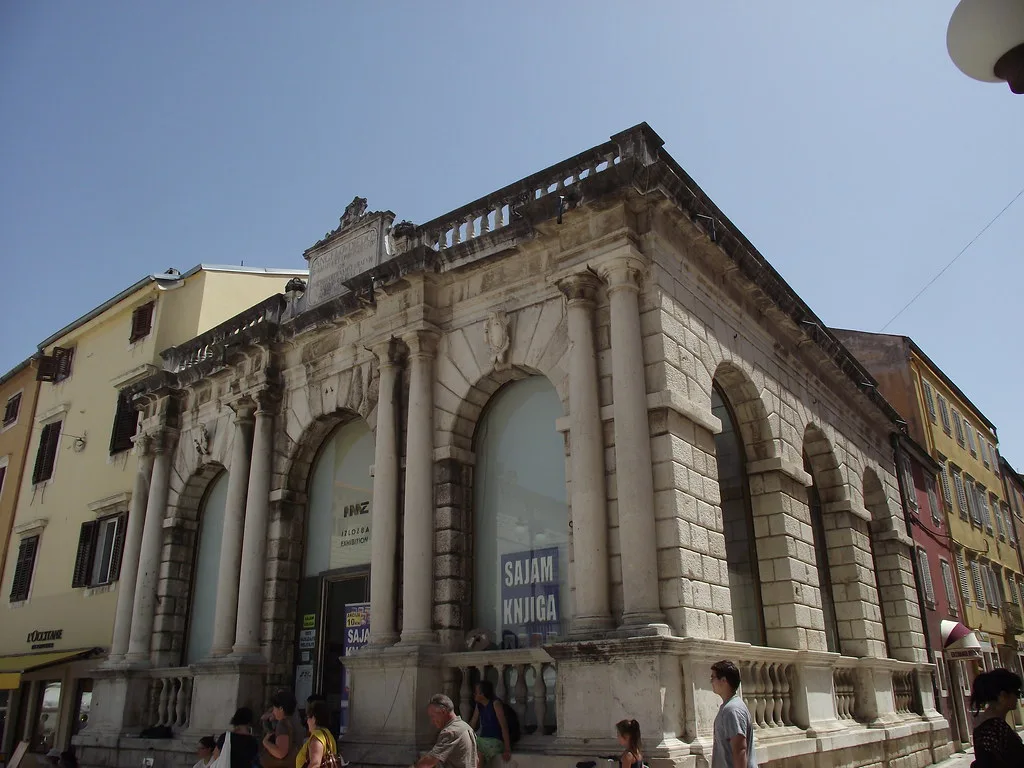
Opposite the guard tower, the City Lodge faces the square, and on the east side stands the City Council building, constructed in 1935. The mixture of periods is the point: a Renaissance square with a twentieth-century civic block on one flank is how Croatian old towns actually evolved, rather than being frozen at a single date.
Look also for the reproduction of a nineteenth-century street lamp on the square, a small piece of civic dressing that completes the ensemble. None of this is labelled as an exhibit, which is why it helps to know what you are looking at before you arrive.
Sitting down: cafés and people-watching
Narodni trg is a café square above all else, and the terraces set out across the paving are the main way visitors use it. There is no ticket, no turnstile and no closing time to plan around: you decide how long you stay. Order something, take a seat and watch the city go about its business, which is what Zadar has done here for centuries.
Order something, take a seat and watch the city go about its business, which is what Zadar has done here for centuries. In high summer, the shaded corner seats go first.
How long to allow and how to combine it with the rest of the old town
Budget ten to fifteen minutes for the square itself and longer if you sit down; it does not need a dedicated half-day. The efficient route runs from the Roman Forum, past the Church of St Donatus, south down Kalelarga to Narodni trg, then on to Trg Petra Zoranića and Trg pet bunara before looping back to the waterfront. That way you never retrace your steps along the same street.
Finish at the water with the sea organ Zadar and the Greeting to the Sun, both a short walk from the southern end of the peninsula and best saved for the end of the afternoon. The Sea Organ's steps are the obvious place to rest after a morning on the stone.
If you want a museum in the mix, the archaeological museum Zadar sits close to the Forum and fills the historical gap between the Roman city and the Venetian one. Allow it an hour of its own rather than trying to fold it into the square visit.
Nearby: Trg Petra Zoranića and Trg pet bunara
Continue south down Kalelarga from Narodni trg and you reach Trg Petra Zoranića, named for the Renaissance novelist and marked by a large Roman column and ancient ruins set under glass. It is a cooler, quieter square than Narodni trg and a good place to sit in shade. Keep going and you arrive at Trg pet bunara, the Square of Five Wells, laid out around the five cisterns that once served the city.
Beside Trg pet bunara is the Perivoj kraljice Jelene Madijevke, the first public park in Croatia, laid out on raised ground above the old defensive works. If it is open when you pass, climb the Kapetanova kula for a view back over the rooftops.
Other nearby stops worth knowing include the Church of St Simeon, the Museum of Ancient Glass and the Land Gate at the northern edge of the old town. The Museum of Illusions Zadar is a livelier option if you are travelling with children.
When to go: morning versus evening
Mornings on Narodni trg are about coffee and errands, with the terraces half full and the light coming in across the paving. Evenings are busier and louder, with locals taking the evening stroll that fills Croatian squares in summer. If you want the square to yourself for photographs, come early and come first.
In high summer the stone holds heat and the square stays warm well into the evening, while the bura wind can clear it of people within an hour. Outside July and August the terraces thin out considerably and the square reverts to something closer to a neighbourhood.
Is the People's Square worth a stop?
Yes, but as a pause rather than a sight. Narodni trg costs nothing, sits directly on the Kalelarga route between the Roman Forum and Trg pet bunara, and rewards ten minutes of looking at its four sides instead of walking through with your phone up. Build it into a morning that also takes in the Church of St Donatus Zadar and the waterfront, and it will feel like part of the city rather than a box ticked.
If you only have an hour in town, do the Forum, Kalelarga and this square in that order and leave the museums for another visit. Anyone staying longer can add the Zadar city walls walk and the Archaeological Museum without hurrying.
Frequently Asked Questions
Is Narodni trg free to visit?
Yes. It is an open public square used as a meeting and café space rather than a ticketed sight, and there is no entrance to pay for or gate to pass through to reach it.
Where is Narodni trg in Zadar?
It sits in the middle of the historic peninsula in Zadar's old town, a few minutes' walk south of the Roman Forum down Kalelarga, the street also known as Široka ulica.
How long do you need at Narodni trg?
Ten to fifteen minutes is enough to read the four sides and move on; allow longer if you take a table at one of the cafés.
What is there to see on the square?
Look for the sixteenth-century City Guard clock tower on the north side, the City Lodge and the 1935 City Council building on the other sides, and the reproduction of a nineteenth-century street lamp.
What else is nearby?
The Roman Forum and Church of St Donatus lie to the north, Trg Petra Zoranića and Trg pet bunara continue south down Kalelarga, and the Sea Organ and Greeting to the Sun sit by the water.