
Church of St Donatus, Zadar: What to See Inside the Round 9th-Century Church
The Church of St Donatus is a short visit, not an afternoon: most travellers need 20 to 30 minutes inside, though the attraction listing suggests allowing one to two hours for the church and its immediate surroundings. It is Zadar's signature pre-Romanesque building, a circular stone church founded in the 9th century, and it is no longer used for religious services. This guide covers where it stands, what the round plan means, what to look for inside, and how to slot it into a walk through the Old Town, alongside the Sea Organ Zadar and the Roman Forum Zadar.
What the Church of St Donatus is, and what it is not
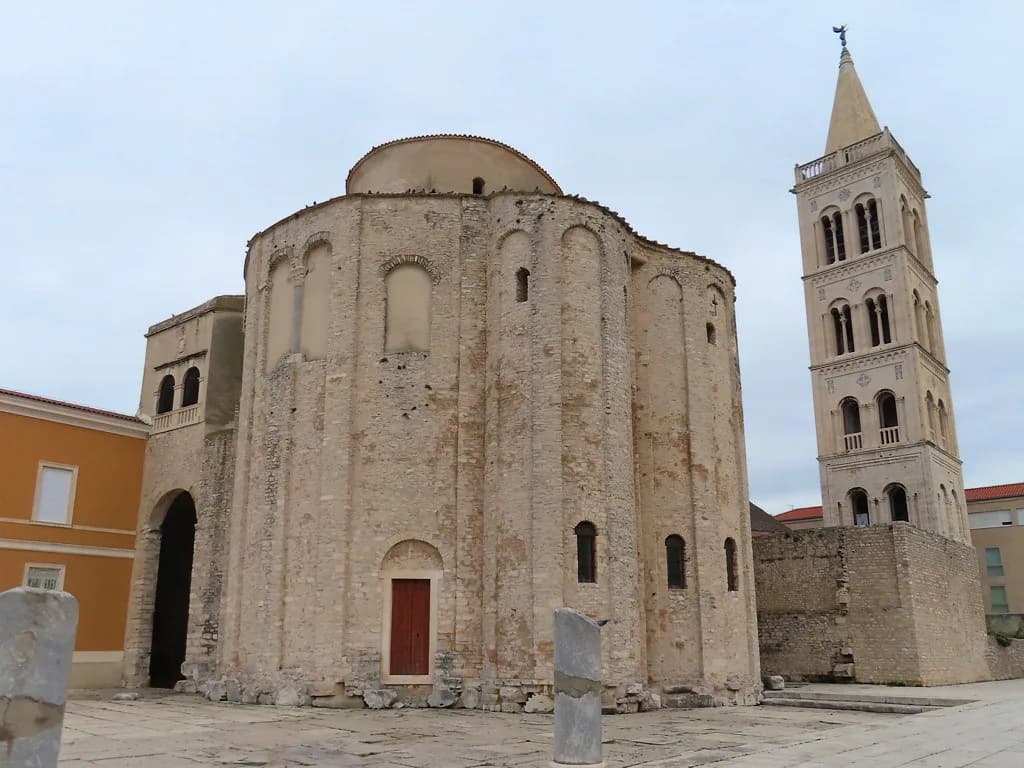
St Donatus is a pre-Romanesque round church, founded in the 9th century when it was dedicated as the Church of the Holy Trinity; it took its present name about six hundred years later in memory of a Bishop. Its circular form is characteristic of the early Byzantine age in Dalmatia, and the building is widely taken as the symbol of the city. Come expecting architecture and acoustics rather than an active parish church.
No religious services are held here now, so there is no Mass timetable to plan around. Instead the building works as a concert and cultural venue, which shapes how you experience it: you are walking through a performance space with bare stone walls and a very particular sound. The cathedral belltower rises directly beside it, a sign of how tightly the monuments of the Old Town sit together.


Where it is: Poljana pape Ivana Pavla II
The church stands on Poljana pape Ivana Pavla II, the square formed around the remains of the Roman forum in the heart of the Old Town. The forum ruins lie directly in front of the building, and St Anastasia's Cathedral is a matter of metres away, so you get three layers of the city's history in one small space. One listing gives the neighbouring street Grgura Mrganića as the church's address, so navigate by the square and the round building rather than by a street number.
Because the square is open and pedestrian, there is no gate to find and no ticket barrier to cross before you see the exterior; the round drum and its stonework are visible from the forum side. Treat the square as the approach and the church interior as the destination, and the stop compresses easily into a wider walk rather than needing a dedicated trip.
How to get there on foot through the Old Town
Zadar's Old Town sits on a peninsula, and the church is reached on foot, typically from the landward end through the Land Gate or from the waterfront Riva. Whichever way you enter, aim for the forum square rather than a street address, because the church is the landmark itself. Allow a slow ten to fifteen minutes from the city gate area if you stop to look at the streets on the way.
The square is the busiest kind of public space in summer: open, sunny and on the route between the waterfront and the cathedral. If you want the exterior without a crowd in the frame, come early in the morning or in the evening rather than midday. The interior is the reason to linger, so build in a pause rather than treating the church as a photo stop.
What to see inside: the circular nave and three apses
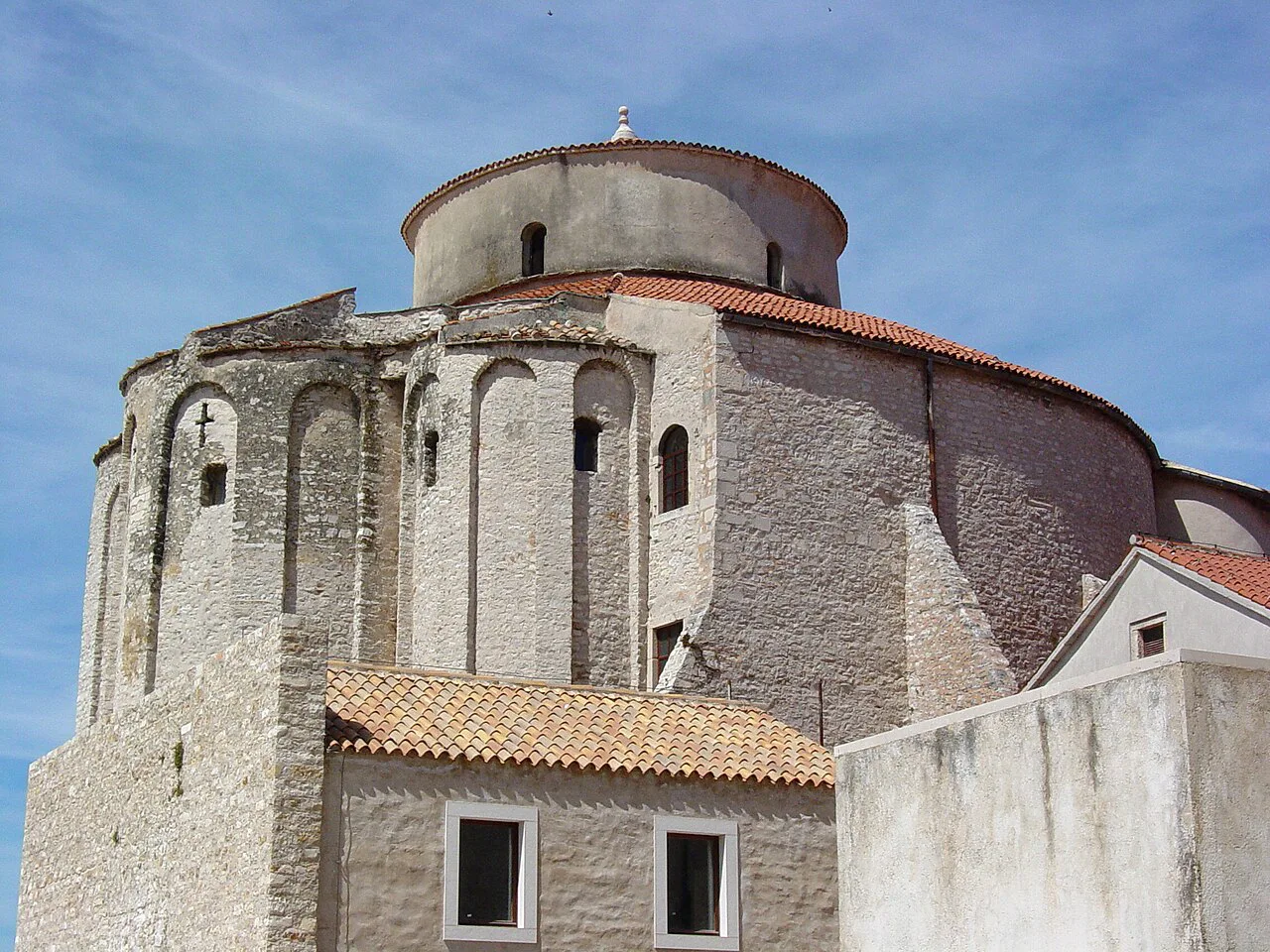
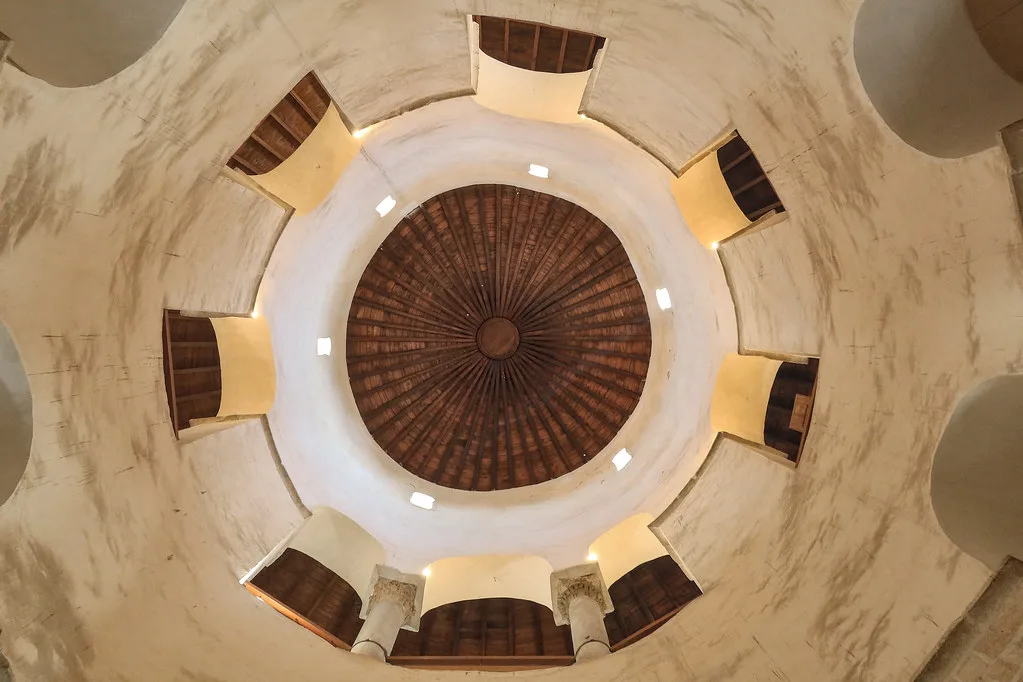
Inside, the plan is a double-layered circle: a circular nave wrapped by a ring of columns and piers, opening into three semicircular apses. The interior is stark rather than decorated, which is exactly what makes the geometry readable at a glance. Walk the full circuit before stopping, because the proportions shift as you move round the ring.
The dimensions explain the impression of mass: the circular nave has a diameter of roughly 22 metres and the building rises about 27 metres. Thick stone walls and the curved plan produce the acoustics the venue is known for, so sound behaves quite differently here from a rectangular basilica. Look up at the drum and the ring of openings rather than only at eye level, where the stonework is plainest.
Why the round shape matters
The round plan places St Donatus in a small group of early medieval round churches, and its style blends Byzantine and Carolingian elements, with recognised similarities to the Palatine Chapel at Aachen and the Basilica of San Vitale in Ravenna. That comparison is the quickest way to understand why a circular church in a Dalmatian town feels unexpectedly imperial.
It is also one of the largest surviving pre-Romanesque buildings in Croatia, which is the reason it anchors the city's self-image rather than sitting quietly off the main route. If you have already seen the Roman forum stones outside, the church makes sense as the next layer: antique foundations, then an early medieval building raised on and beside them.
Acoustics and the Musical Evenings in St Donatus
The reason the church still functions is its sound. The bare interior has excellent acoustics and hosts the International Festival of Medieval Renaissance Music, known as the Musical Evenings in St Donatus, which the listing describes as an annual event. Performances have been held here since 1961, so the building's second life as a concert hall is decades old rather than a recent rebranding.
Programme dates and ticketing for any given summer are set by the festival organisers, so check the current schedule rather than assuming a concert will fall in your week. Even without a performance, the acoustic is worth testing quietly with a few words when the room is not busy, while respecting other visitors and any event setup in progress.
How much time to allow, and when to go
Budget 20 to 30 minutes for the church itself, which is enough to circle the nave, read the apses and listen to the room. The attraction listing recommends one to two hours for a visit, which makes sense if you count the forum, the cathedral next door and a coffee on the square. Build the stop into a wider Old Town walk rather than making it the whole outing.
For fewer people, aim for opening time or the last part of the day; the middle of a summer day brings the heaviest flow between the Sea Organ and the forum. The square has almost no shade, so a midday interior visit doubles as a break from the sun. The bura can make the open square bracing in shoulder season, so a light layer helps even in a warm month.
Opening hours and entry: what to check before you go
Hours change with the season. The venue listing gives 09:00 to 19:00 in general and 09:00 to 21:00 in August, while the attraction listing shows a 09:00 to 17:00 day, so treat any single figure as season-dependent rather than fixed. Check the current times on the day, especially outside July and August, and around concert days when the interior may be prepared for a performance.
No fixed entry fee is stated for the church, so do not plan around a set ticket price; ask at the entrance or check locally before you plan around it. Both listings carry a contact number if you want to confirm access in advance. Croatia uses the euro, so any small charge you do meet will be in euros rather than kuna.
Nearby sights within a few minutes
The Sea Organ, where waves push air through submerged pipes, is about 387 metres away, and the City Gate is around 528 metres, both free to visit. St Anastasia's Cathedral is effectively next door, and Zadar Market is roughly 286 metres off, which makes a natural circuit: forum, church, cathedral, market, then the waterfront. Zadar Attractions: 13 Visitor Guides covers the rest of the Old Town if you want to extend the day.
If you are collecting the city's museums, the Museum of Ancient Glass, Zadar keeps Roman glassware from the region's necropolises and pairs well with the forum outside the church. The archaeological museum Zadar, known locally as Arheološki muzej Zadar, fills in the long sequence from prehistory to the medieval city. Either one turns a short church stop into a half day.
Two more Old Town stops round out a walk: the Church of St Simeon in Zadar, which holds a celebrated silver sarcophagus, and Narodni trg Zadar, the main civic square with the clock tower. Both sit within the peninsula and cost nothing to look at from outside. Keep the church as the centre of the morning and let these fill the edges.
Is St Donatus worth stopping for?
Yes, as a short architectural stop with outsized payoff: the round nave, the ring of columns and the three apses are unlike anything else on the coast, and it sits in the middle of a walk you were doing anyway. Go early or late, check the day's opening times, and pair it with the forum stones outside and the Sea Organ a few minutes away.
Explore more Zadar guides
Frequently Asked Questions
Is the Church of St Donatus still a working church?
No. Religious services are no longer held in the building, which now serves as a concert and cultural venue and hosts the Musical Evenings in St Donatus festival.
Do I need a ticket to go inside?
No fixed ticket price is published, so ask at the entrance or confirm locally on the day. Pay any charge in euros, Croatia's currency since 2023.