
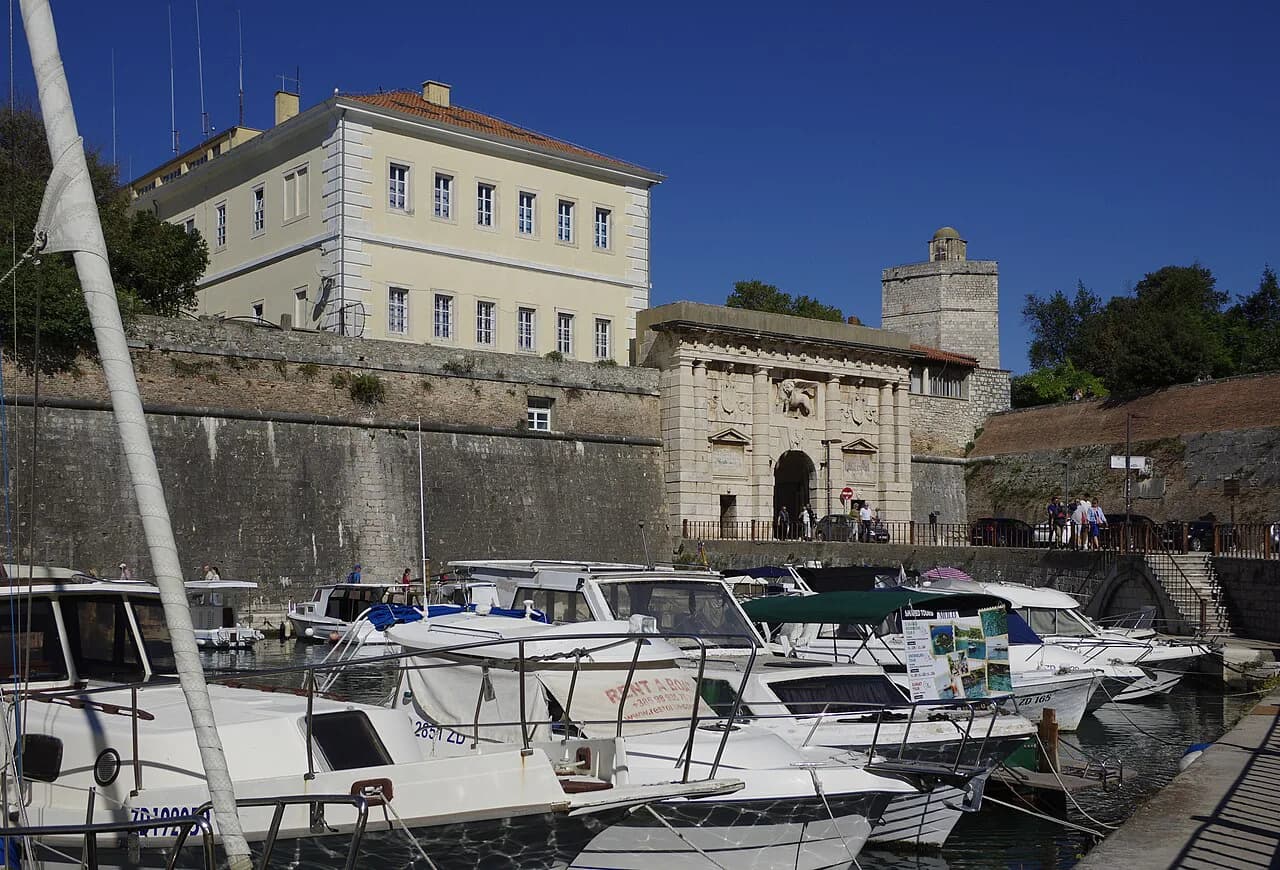
Land Gate (Kopnena vrata), Zadar: What to See and How Long to Allow

The Land Gate, or Kopnena vrata, is the grandest way into Zadar's old town and costs nothing to see: it stands open all day beside the Foša harbour at Ul. Među bedemima, and a visit takes 15 to 30 minutes. This guide covers where it sits, how to walk to it, what to look for on the façade and what is close enough to combine with it.
What the Land Gate is and why it matters
The Land Gate was designed by the Venetian architect Michele Sanmicheli and completed in the mid-16th century; a 1543 date is attached to it as part of the Republic of Venice's fortifications. It was built as a ceremonial entrance to the walled town rather than a mere gap in the defences, and it still reads that way. For a visitor arriving from the bus station or the ferry port, it is the point where modern Zadar gives way to the old peninsula.
Its design copies the form of a Roman triumphal arch: a wide central opening once used by carriages and horses, flanked by two narrower openings for pedestrians. The columns carry a pediment above, which gives the gate a formal, stage-like proportion that suits its role as the town's front door.
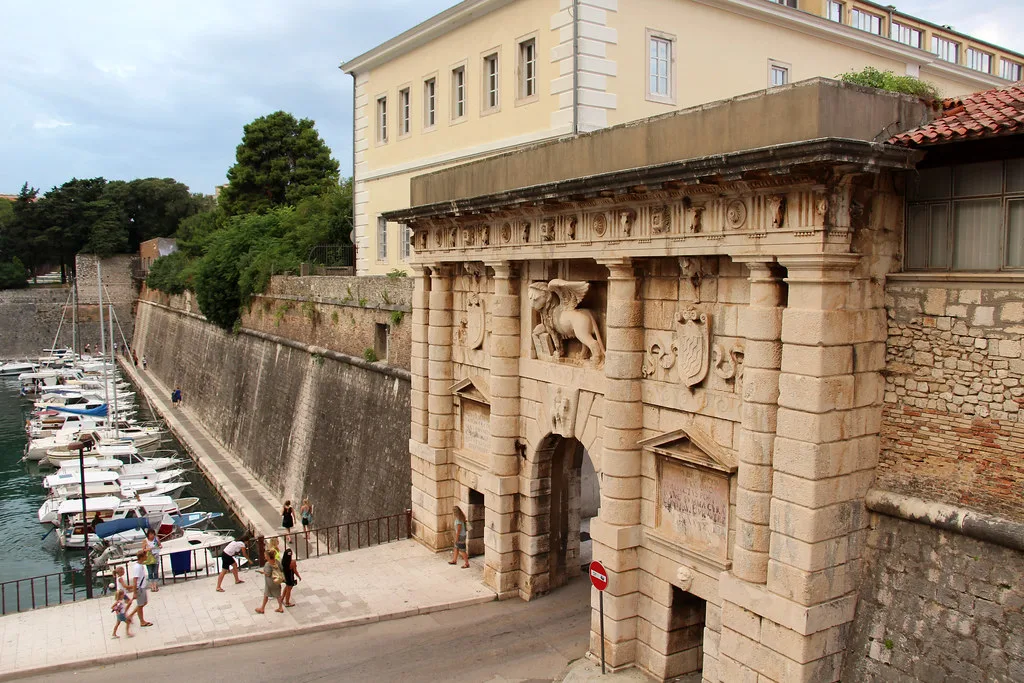
Where the Land Gate is: Foša harbour and Ul. Među bedemima
The gate faces the small fishing port of Foša, at the north-eastern edge of the old town, and its address is given as Ul. Među bedemima. If you are coming from the main bus station or the onward ferry berths, you approach along the harbour side and the gate appears ahead of you across the water.
Foša itself was once the city moat, and the water in front of the gate is the remnant of that defensive channel turned into a harbour corner. Standing there, you get a clearer sense of how the entrance was meant to be approached — across water, under a fortified wall, into a controlled passage.
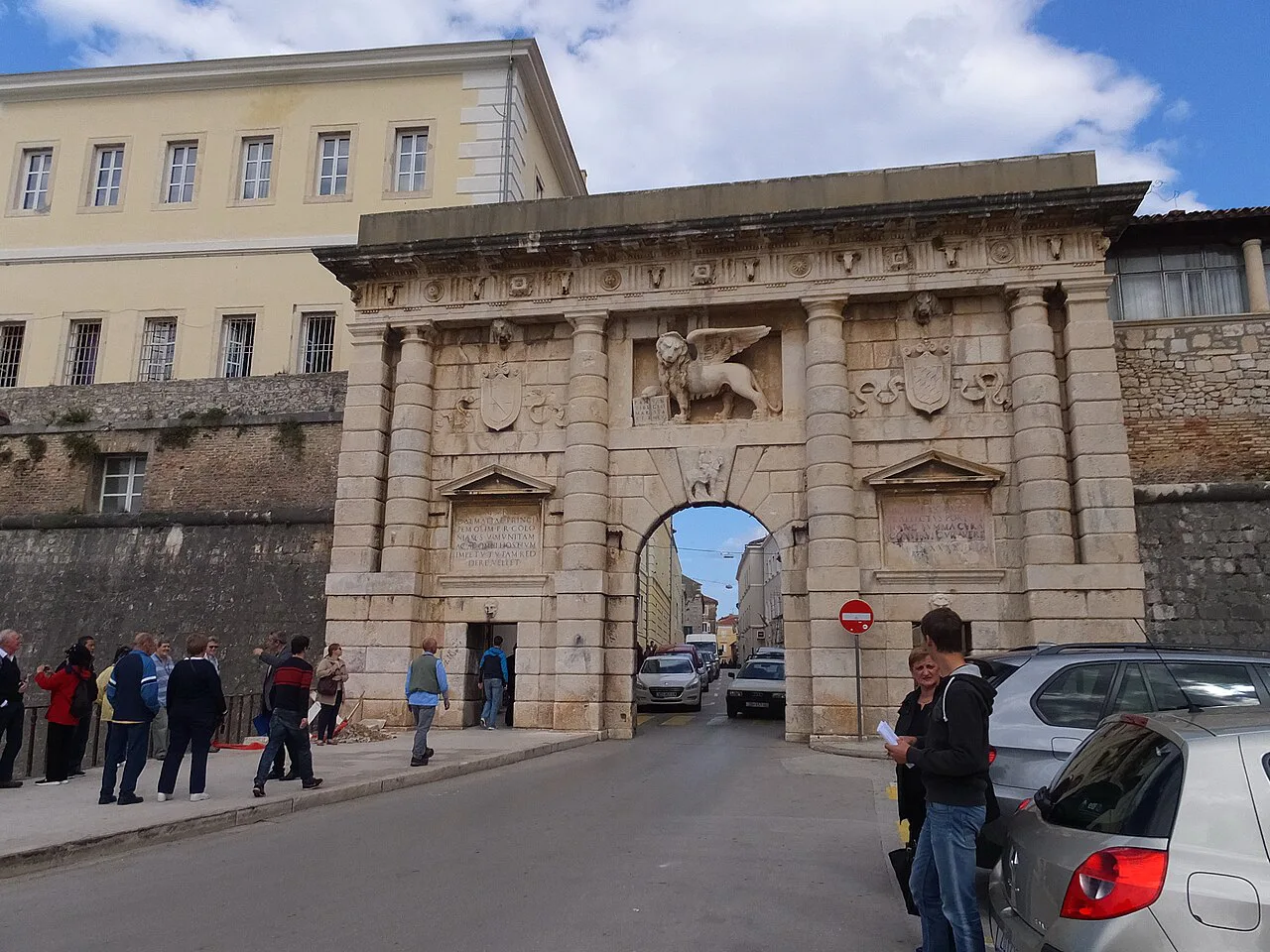

How to reach it on foot from the old town and the Roman Forum
Inside the walls, the gate opens onto the straight streets of the old town, and the Roman forum Zadar lies a short walk away, with the Church of St Donatus beside it. Many visitors reach the Land Gate from that direction, having wandered down from the forum towards the harbour.
On foot, the simplest approach is to follow the waterfront around the north-east side of the peninsula until the harbour narrows at Foša. The old town's lanes are pedestrian-only, so walking is the practical way in; the gate is a five- to ten-minute stroll from the forum area depending on how often you stop. Distances on the peninsula are short, and the gate sits within walking distance of the Sea Organ and the main squares.
The city walls that frame the gate are part of the same fortification system, and walking a stretch of them before or after passing through gives the gate its context. The Zadar city walls page covers where you can walk and what the ramparts look like from above.
What to look for on the façade: the Lion of St. Mark, St. Chrysogonus on horseback and the three arches
Above the central arch, the carved decoration is the reason to slow down. The winged Lion of St. Mark, the emblem of Venice, shares the frame with a relief of St. Chrysogonus riding a warhorse — Zadar's own patron saint on one side of the message, the Republic's mark of ownership on the other.
Look at how the three openings are arranged: the central arch is the tallest and widest, and the two side passages are lower and narrower. That hierarchy tells you at a glance which traffic the gate was built to carry, and it is easiest to see from a few steps back on the harbour side.
The masonry is plain, pale stone, and the gate's power comes from proportion rather than ornament; the lion and the saint are the only real sculptural flourishes. Come close to read the carving, then step back across the road to see the whole composition of arch, columns and pediment at once.
Passing through: how the gate relates to the old town and the former moat
Walking through the Land Gate puts you directly into the grid of the old town, with the forum, the cathedral and the Riva within a few minutes. Treat the gate as the threshold rather than the destination: it works best as the first stop on a walk that continues inland. The Zadar Attractions: 13 Visitor Guides page helps you sequence the rest of the peninsula.
The chain of defences continues around the peninsula, and the moat that once lay in front of this gate is now part of the harbour scene. That change is worth noticing: the very feature that made the entrance hard to attack now frames the most photogenic approach to it.
How long to allow and the best times to photograph it
Plan on 15 to 30 minutes at the gate itself, which is enough to study the carvings, walk through and look back from both sides. Early morning and evening give softer light and thinner crowds, and those are the windows most likely to leave the arch clear for a photograph.
Midday in summer brings the harbour crowds and hard shadows across the façade, so if you want the lion and the saint readable in a picture, come earlier or later. The gate is a working entrance, not a walled exhibit, so people will pass through your shot whatever the hour.
Is there a ticket or opening time?
There is no ticket: entry is free and the gate is open all day, every day, because it is a public passage rather than a staffed monument. That makes it easy to fit around ferry times or an early start, and there is nothing to book.
Guided walking tours of the old town sometimes include the gate as a stopping point, but the structure itself needs no ticket and no guide to appreciate. If you want commentary on the Venetian fortifications, ask at the tourist information desk in the old town about what is running during your stay.
Nearby: the Roman Forum, Church of St. Donatus, Sea Organ and Zadar Market
The Roman forum is the natural next stop, with the Church of St Donatus Zadar standing among its paving stones and the cathedral a street or two beyond. All of these sit within a short walk of the gate, so the whole cluster can be done in a single morning.
Head west along the waterfront and you reach the sea organ Zadar, where the tide pushes air through pipes set into the steps, and the Greeting to the Sun, a glass disc that lights up after dark. Both are free and open, and both are best at sunset when the light drops over the Adriatic Sea.
The Zadar Market sits a few minutes inland from the gate and is the place to see the produce side of the city rather than the monumental one. Combine it with a wander through Narodni trg, the main square of the old town, and the Five Wells Square near the Land-side walls.
Is the Land Gate worth a stop?
Yes, on the way in rather than as a trip of its own: the Land Gate is free, open all day and takes half an hour at most, so it earns its place as the start of a walk through Zadar Old Town. Build it into a route that continues to the forum, Donatus and the Sea Organ, and it becomes the opening scene of a good half-day.
If you are in Zadar for a day, pass through the gate early, before the harbour fills up, then work west towards the waterfront. Skim the trip-planning material first so you know which sights you want to prioritise on the peninsula.
Explore more Zadar guides
Frequently Asked Questions
Is the Land Gate in Zadar free to visit?
Yes. The Land Gate is a public passage into the old town, not a ticketed monument, and it can be walked through at any hour. There is no booking and no entrance charge.
How long does it take to see the Land Gate?
Most visitors spend 15 to 30 minutes at the gate, which covers studying the carvings and looking back at it from the harbour side. It is usually combined with the Roman Forum and the Sea Organ a short walk away.
What is carved on the Land Gate?
The reliefs show the winged Lion of St. Mark, the symbol of Venice, alongside a figure of St. Chrysogonus on horseback, Zadar's patron saint. The three-arch layout echoes a Roman triumphal arch, with the wide central opening for carriages and narrower ones for pedestrians.
Where exactly is the Land Gate?
It faces the Foša harbour at the north-eastern edge of the old town, on Ul. Među bedemima. Approaching from the bus station or ferry berths, you walk along the waterfront until the harbour narrows at the gate.
Do I need a guide to understand the Land Gate?
No. The architectural details are visible from the street and the gate is easy to read on your own. Guided walking tours of the old town sometimes include it if you want the Venetian history explained.