Imotski Lakes: Croatia's Blue Lake and Red Lake Guide
The Imotski lakes are two karst sinkhole lakes beside Imotski in the Dalmatian hinterland. Here is what the Blue Lake and Red Lake are and how to see them.
On this page
The Imotski lakes are two karst sinkhole lakes beside the town of Imotski in Split-Dalmatia County: the Blue Lake, known in Croatian as Modro jezero, and the Red Lake, Crveno jezero. Both sit in dramatic rocky depressions, but they work differently for a visitor, since the Blue Lake is the one you approach from the town and the Red Lake is looked at from above. This guide covers what each lake is, how to see them and where they fit in a trip through the Dalmatian hinterland.
What the Imotski lakes are
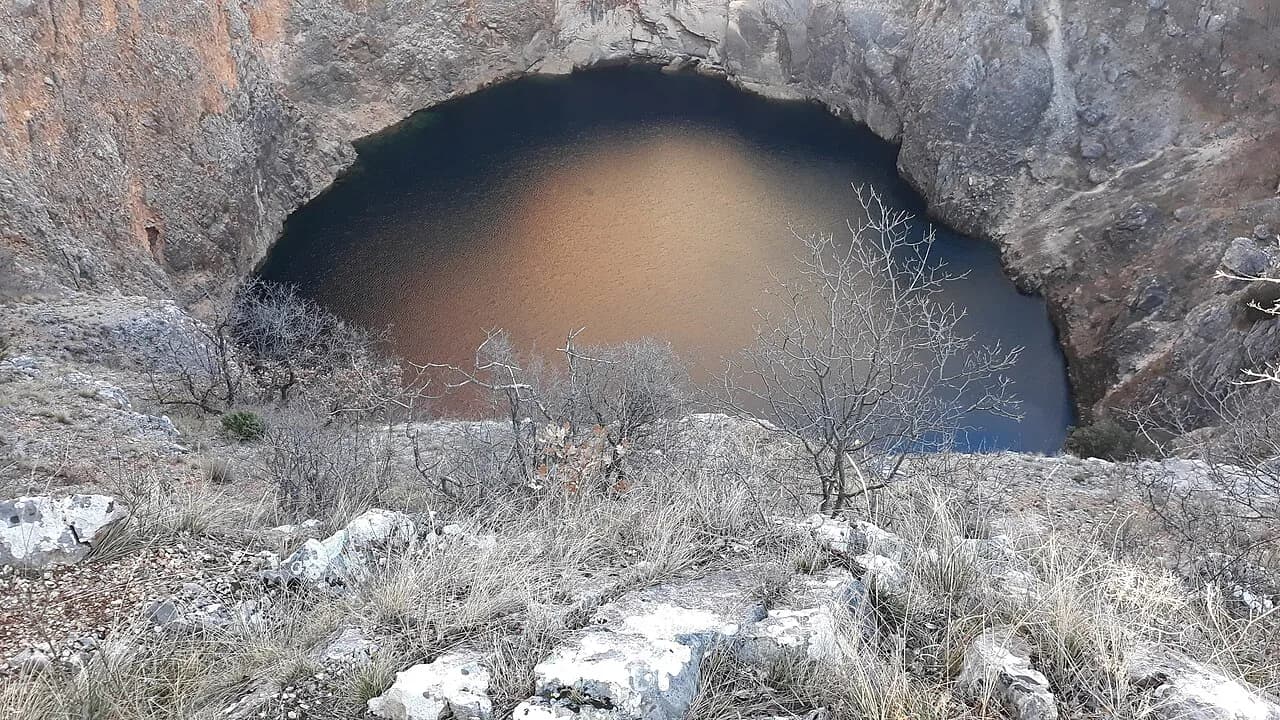
These are not open-water lakes in a valley but karst lakes set in deep sinkholes. The Blue Lake is described as one of the most beautiful karst lakes in Croatia and is believed to be among the deepest lakes in Europe, which explains the sheer cliffs that ring it rather than gentle shores.
The two lakes sit just outside Imotski, the town that gives them their name, in Split-Dalmatia County, a part of inland Dalmatia better known for stone villages and vineyards than for water. The Blue Lake is the one most visitors come for, and the Red Lake is the wilder of the pair, seen as part of the same circuit.
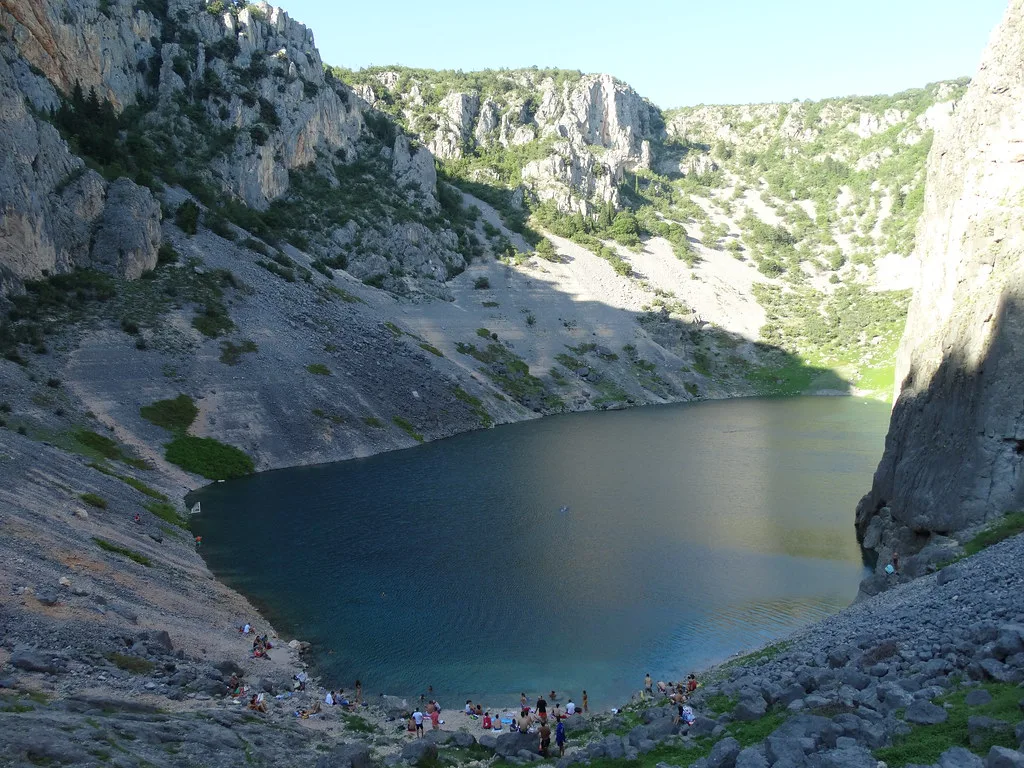
What you actually see depends heavily on the water level. The Blue Lake in particular fills part of its basin in some periods and shrinks back in others, exposing more of the walls and floor of the sinkhole. Treat any photograph you have seen as one version of the scene rather than a guarantee, and set your expectations around the cliffs themselves, which do not change.
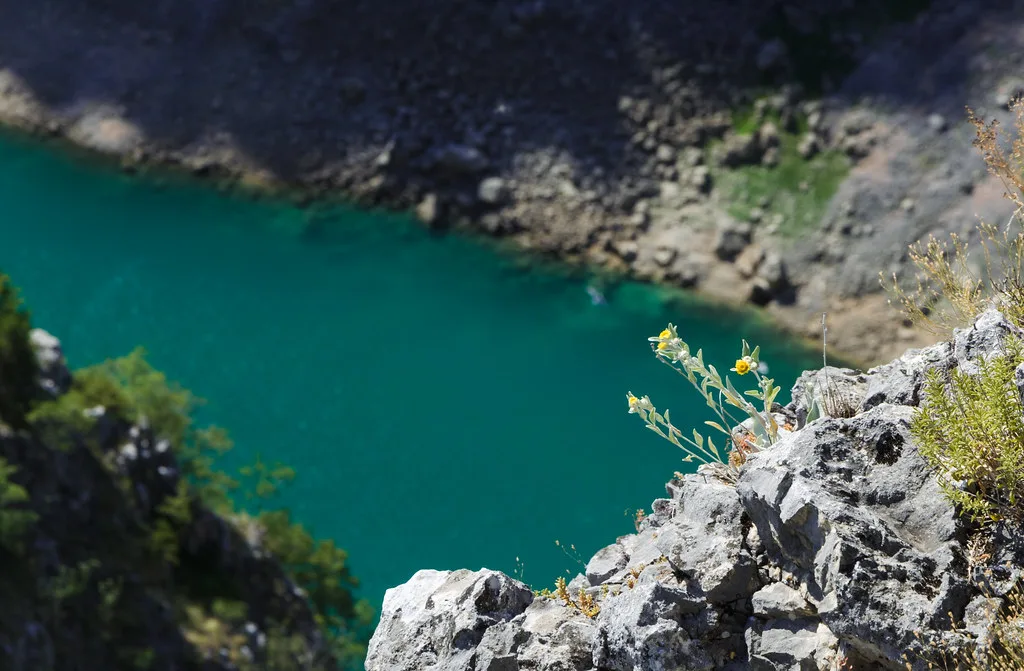
Blue Lake versus Red Lake
The Blue Lake is the one you can approach from the town: you can look down into it from the rim and, when conditions allow, follow a route down towards the water. That makes it the half of the pair to plan around if you want to spend time at a lake rather than simply photograph it.
The Red Lake is the second of the two karst sinkhole lakes and is usually seen as a stop on the same loop as the Blue Lake rather than as a destination at the water. Access conditions at the lake edge are not something to assume, so treat the Red Lake as a stop to combine with the Blue Lake rather than as a place to linger at the water.
The pair sit within an easy circuit that takes in Imotski's own sights, including the Topana fortress in town and the Badnjevica fortress between Proložac and Ričice. That makes a loop of the lakes and the fortresses a sensible way to spend a day based in the town, especially if you have a car.
Viewpoints and access
Plan on the viewpoints being the main event. At the Blue Lake the natural sequence is to arrive at the rim, take in the whole basin, then decide whether to descend. Wear proper shoes rather than sandals, since karst ground is uneven and the edges of a sinkhole are no place for smooth soles.
The descent towards the Blue Lake is best treated as conditional. Ask in Imotski, at your accommodation or at the tourist board, whether the way down is open and how far it currently goes, because the answer depends on the water level and on the state of the route at the time.
Budget time rather than money and keep the visit flexible, then confirm any entry charge or seasonal closure locally before you rely on it.
The town of Imotski
Imotski itself is worth an hour or two beyond the lakes. The Topana fortress above the town is one of the sights to pair with the lakes, and the old centre is small enough to wander without a plan. Pairing the fortress with the Blue Lake makes a compact morning, with the Red Lake added if you have a car and the time.
The town also works as a base for the wider Zagora. Cycling routes in the region cover the country between Dugopolje, Trilj, Sinj and Vrlika, and the Imotski area has its own circuits past the lakes and the fortresses. If you are travelling with bikes, the lanes inland are quiet and the distances short.
Pairing the lakes with the wider Zagora
The Imotski lakes make most sense as part of a hinterland day rather than a coastal one. From Imotski you can head north towards [[The Dalmatian Hinterland]], the inland Zagora country around Sinj and Trilj on the Cetina. Sinj is the centre of religious and cultural tourism in the Dalmatian hinterland and, thanks to the Alka knight's game and its status as a Marian shrine, it draws a growing number of visitors each year.
Nearby, the routes around Trilj lead to stone water mills on the Grab and to the Roman remains at Gardun, which gives you an alternative to another lake stop if you have already seen the Blue and Red Lakes. The Trilj area is also known for the Nutjak fortress on the Cetina.
On the way towards Imotski from the coast you pass Vrgorac, and the nearby village of Kokorići runs cycling circuits through the Vrgorac fields. These are working agricultural landscapes rather than sights with gates, so treat them as scenery and stops rather than ticketed attractions.
When to go
Spring and early autumn are the kindest seasons for inland Dalmatia. Late spring and early autumn are warm enough for exploring towns and inland areas comfortably, while summer heat in the interior can be fierce and the middle of the day is best avoided on exposed karst.
In high summer, plan the lakes for early morning or late afternoon. The rocks around the sinkholes hold heat, and there is little shade at the rims, which is another reason a hat and water matter more here than on the coast. In autumn, some seasonal businesses close towards the end of September, especially those directly on the coast, though that affects seaside stops rather than the lakes themselves.
The bura wind is a hinterland consideration in the cooler months. It can be bitter when it blows, so if you are travelling outside summer, bring a windproof layer even on a sunny day.
Getting there and getting around
A car is the practical choice for the Imotski lakes and the surrounding hinterland. Distances between the villages, mills and fortresses are short in kilometres but poorly served by public transport, and a car lets you chain the lakes with the Cetina sights. If you are relying on buses, plan around Imotski as a single base rather than trying to string together several inland stops in one day.
From the coast, the drive inland is a change of landscape as much as a change of distance. Inland from the beach resorts the scenery shifts to drystone walls, olive groves and fig trees, and in the northern Zagora the hinterland road continues towards Krka National Park and the coast at Vodice. Imotski is further south in the same inland belt, so treat it as its own day rather than a quick detour from Split or Šibenik.
Walking between the viewpoints is feasible for the Blue Lake from Imotski, but the Red Lake is a separate stop better reached by car. Build the day around short drives and short walks rather than a long single hike, and leave slack for the heat and for the uneven ground.
Should you add Imotski to a Dalmatian itinerary?
Yes, if you want inland Dalmatia rather than another coastal town. The Blue Lake is the one to plan around, with a rim view and, when the water and path allow, a way down; the Red Lake is a second stop on the same day. Add the Topana fortress in town and you have a solid half-day to a day without leaving Split-Dalmatia County.
Build the trip around a car and a cooler season if you can, and keep the lakes flexible: water levels change the scene from year to year, so check with the town on arrival rather than planning around a photograph. If your route runs north along the coast, a stop at [[Klis Fortress]] outside Split makes a natural partner to an inland day, and slot Imotski in alongside Sinj and Trilj rather than as an afterthought.
Explore more Dalmatia guides
Sources
- Cycling routes of Dalmatian Hinterland - HomeRent
- The Secret Dalmatian Hinterland near Vodice | PRIKA Pool House
- A Local's Guide to Travel on the Dalmatian Coast — Go Ask A Local
- Dalmatia Travel Guide: Best Places to Visit on the Croatian Coast
- Red and Blue lake - Adventure Croatia
- Blue Lake - All You SHOULD Know Before Going 2026 (w
Notes from the Croatian coast
Optional updates when our guides change.
You might also like
Continue reading
More guides you'll find useful