
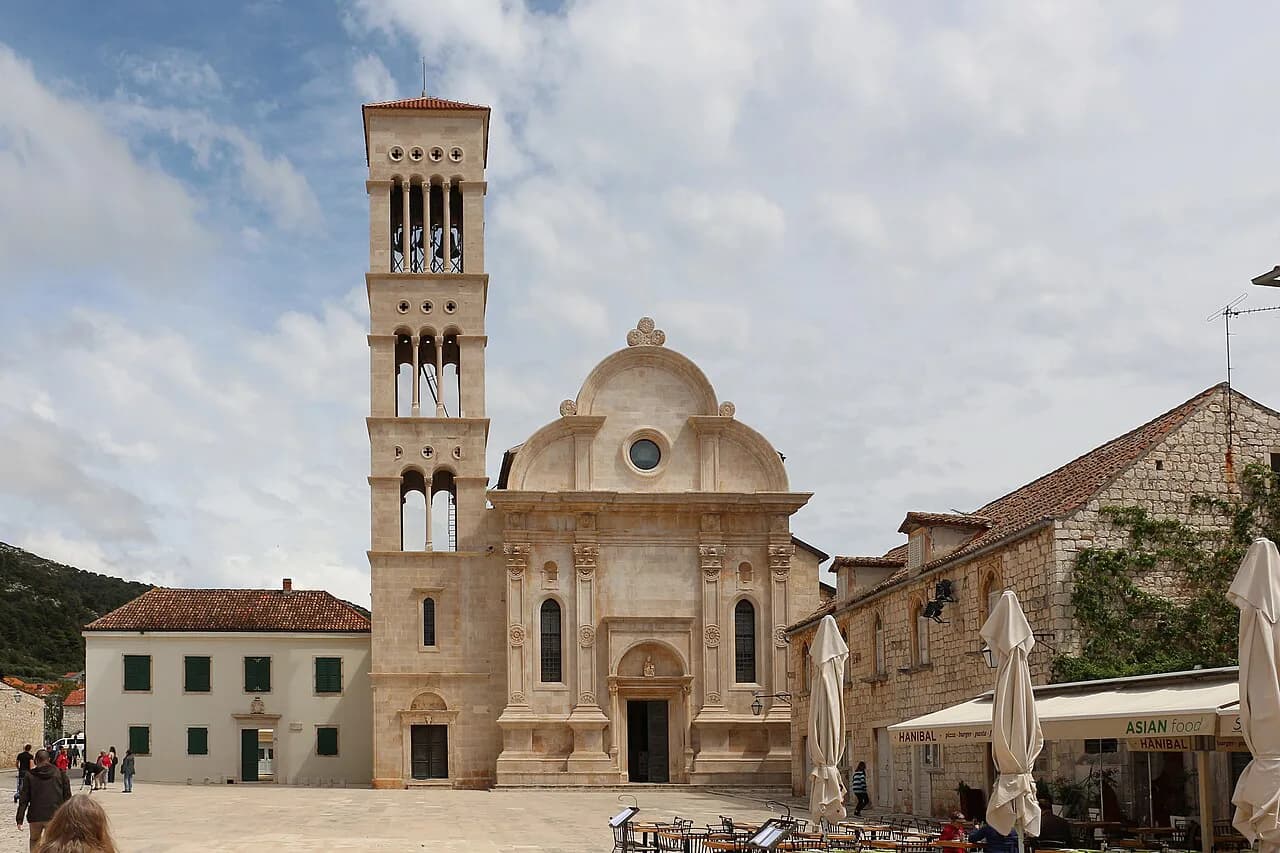
St Stephen's Cathedral, Hvar: visiting the cathedral on the main square

St Stephen's Cathedral stands on Hvar's main square, so you reach it on foot within a few minutes of stepping off the Riva, and it needs roughly 20 to 30 minutes of your day rather than a separate trip. It is the town's cathedral, dedicated to the pope and martyr who is also Hvar's patron saint, and its three-aisled interior holds more than the exterior suggests. This page covers where it sits, what to look at inside, how long to allow and which nearby sights combine with it; it is also one of those covered in Hvar Attractions: 11 Visitor Guides.
Where the cathedral sits in Hvar town
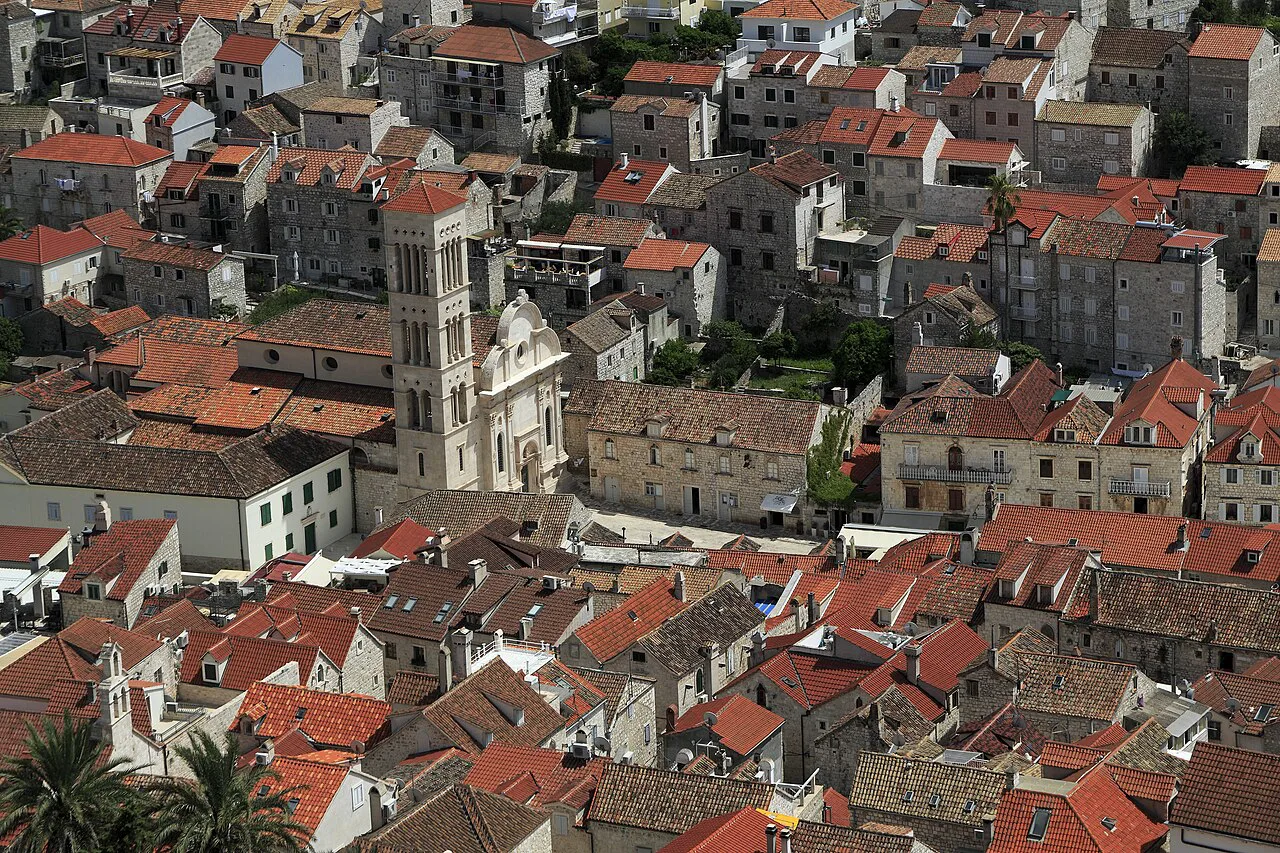
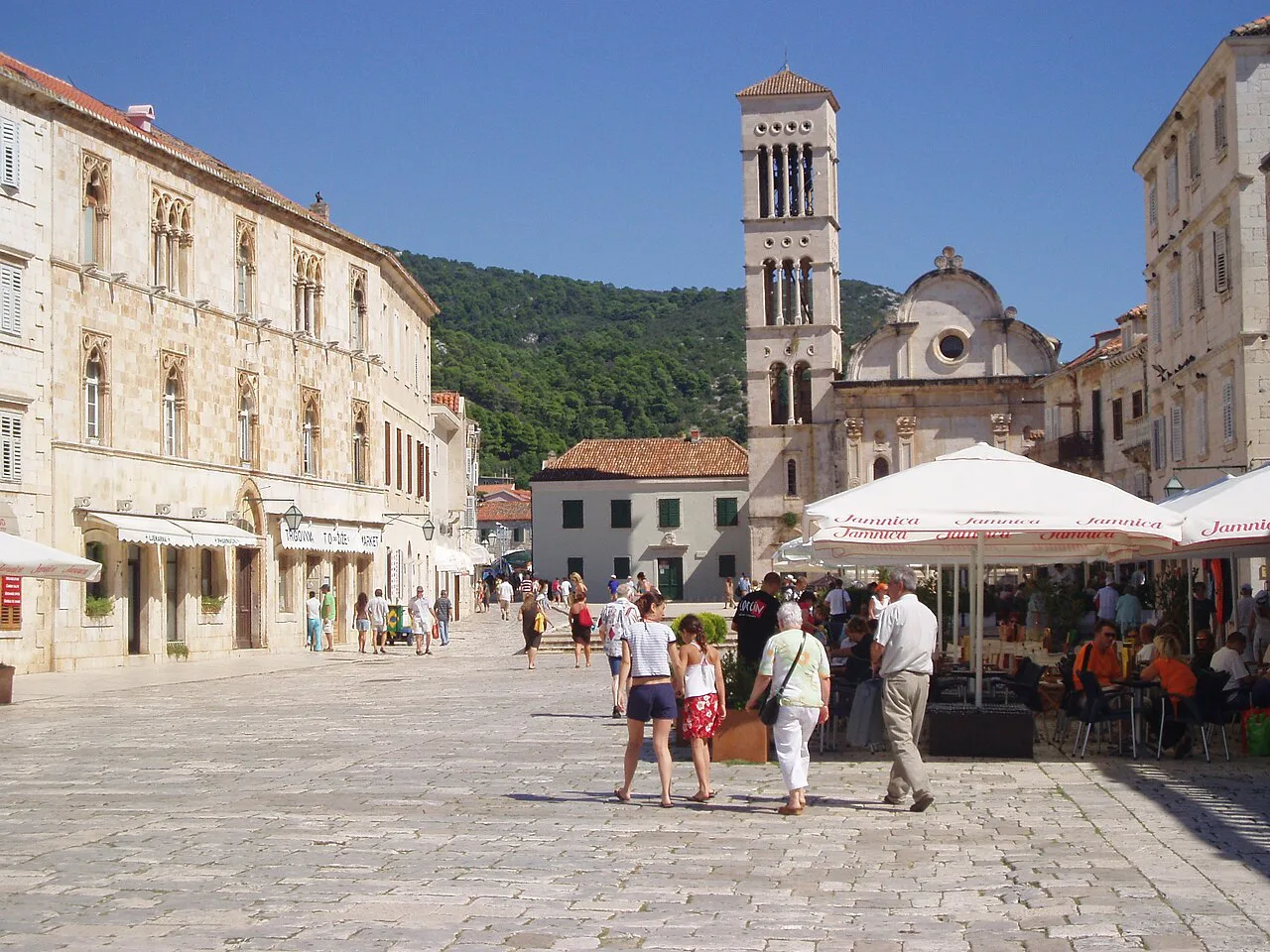
The cathedral fronts the main square, Trg svetog Stjepana, and the old lanes around it are pedestrian, so you do not need transport inside Hvar town; the cathedral is a few minutes from the waterfront. Approach through the lanes behind the square rather than along the quay and you reach the church from behind, where the streets are quieter.
Because the square is the town's main gathering space, the cathedral steps double as a meeting point and a shady place to sit in the middle of the day. An early morning walk through the square is the calmest way to see the façade before the cafés fill.

How Hvar came to have a cathedral
Hvar was a Bishop's seat, which is why a town of this size has a cathedral rather than an ordinary parish church. The building stands on the site of the former Benedictine monastery of St Mary of Lesna, which became a cathedral in the 13th century when the bishopric moved from Stari Grad to Hvar. The present church was built between the 16th and 18th centuries, so what you see is a long accumulation of phases rather than one clean style.
That layered history explains the mix inside: Gothic furnishings sit alongside later Renaissance and Baroque work. It also explains why the cathedral feels different from the Venetian set pieces elsewhere on the coast.

The building in brief: basilica plan and Renaissance sanctuary
Inside, the church is a three-aisled basilica with a square shrine and a Renaissance sanctuary, which gives it a wide, roomy feel rather than the tight single nave of many smaller Dalmatian churches. The main altar sits at the far end of the central vessel, under Palma the Younger's painting.
Allow a moment in the central aisle to take in the proportions before settling at any one altar. The nave is where the building's 16th- to 18th-century building phases read most clearly, and it is also the most comfortable place to stand when a service is not in progress.
Gothic altars and pulpits
The interior is dominated by altars and pulpits from the Gothic period, which is the part of the cathedral a hurried visitor most often walks past. Take a slow circuit of the side walls and the aisle chapels to find them, and look at the carved stonework of the pulpits as closely as the paintings.
Gothic work here is older than the Baroque overlay, which makes it a useful marker for how the cathedral was furnished before later generations remodelled it. If you only have ten minutes, choose the pulpits over the peripheral altars: they are harder to see anywhere else in the town.
The nine Baroque altars and their Venetian paintings
Nine Baroque altars from the 17th century line the church, decorated with paintings by Venetian artists, and this is where the cathedral rewards a slower look. Read the altars as a group rather than one by one: the sheer number is what makes the interior distinctive.
The Baroque phase arrived after the Gothic furnishing, so the altars sit against earlier stonework and give the side aisles their dense, layered look. Give the altar walls at least ten minutes if you want to look at the paintings properly.
Palma the Younger on the main altar
The painting by Palma the Younger on the main altar is the most prominent single artwork in the cathedral, and it is the one to seek out first. It hangs above the main altar at the heart of the interior.
Palma the Younger's canvas ties Hvar's cathedral to the artistic world of Venice, where the Baroque altarpieces around it were also painted. Give it a few minutes before you move on round the altars.
The façade and its three-cornered gable
The late Renaissance façade is finished with a three-cornered gable that symbolises the Holy Trinity, a detail easy to miss from the busy square below. Step back towards the middle of the square to see it properly, and see how the gable crowns the whole front rather than sitting as decoration.
The façade is at its best in the softer light of late afternoon, when the square is still busy but the stonework is not bleached flat by midday sun. Step back across the square to get the whole front in one view.
The bell tower on the north side
The bell tower stands on the north side of the church and was built by local builders in 1549–1550, so it predates much of the present Baroque interior. Its position on the north flank is a useful way to orient yourself when the lanes round the square become confusing.
If you are interested in the town's old buildings, walk around the north side after leaving the church to see the tower from below rather than only from the square.
How long to allow, and the square's cruise-ship rhythm
Twenty to thirty minutes covers the nave, the main altar painting and the nine Baroque altars at a reasonable pace; a slow look with the Gothic pulpits and side chapels adds another quarter of an hour. Hvar's square fills when excursion groups and cruise-ship passengers come ashore, so an early morning or late afternoon visit is the calmer choice.
When a service is being held, treat the cathedral as a working church rather than a sight and keep your visit brief and quiet. It is the town's cathedral, so its routine takes priority over tourism.
Opening hours and mass times
Opening hours and any entry arrangements are set locally, so confirm them at the cathedral or with the tourist office on the square on the day. Hours can change with the season and with services.
Mass times are local parish information too, so check them at the cathedral rather than assuming a previous year's notice still applies. If a service is the reason for your visit, check the time before you plan the rest of your morning around it.
Nearby sights that combine with a visit
The clock tower and the Hvar Arsenal, with the theatre above it, sit on the same square, so both follow naturally from the cathedral without another walk across town. The Riva is a short stroll west towards the harbour, and the Franciscan Monastery, Hvar is the other church stop worth adding to the same walk.
Allow half a day for the cathedral, the square and one of these neighbours, and walk back towards the waterfront afterwards; the climb above town can wait for another morning.
Is the cathedral worth the stop?
Yes, if you are already crossing the main square, which nearly every visitor to Hvar town does: the cathedral adds the nine Baroque altars and Palma the Younger's main altarpiece to a walk that costs you half an hour. Skip it only if your time on the island is so tight that the fortress or the Riva is all you can manage.
Treat the cathedral as the anchor of a square-and-old-town circuit rather than a destination in its own right, and pair it with the Arsenal and a walk along the Riva to make a proper morning of it.
Explore more Hvar guides
Frequently Asked Questions
Where is St Stephen's Cathedral in Hvar?
It stands on Hvar's main square, Trg svetog Stjepana, in the middle of the old town, a few minutes on foot from the Riva and the waterfront.
How long does a visit take?
Around 20 to 30 minutes covers the nave, the main altar painting and the nine Baroque altars at a reasonable pace; allow an extra quarter of an hour for the Gothic pulpits and side chapels.
When was the cathedral built?
It stands on the site of the former Benedictine monastery of St Mary of Lesna, which became a cathedral in the 13th century when the bishopric moved from Stari Grad to Hvar. The present church was built between the 16th and 18th centuries.
Are there opening hours or an entry fee?
Opening hours and entry arrangements are set locally; confirm them at the cathedral or with the tourist office on the square on the day.
What else is nearby?
The clock tower and Hvar Arsenal, with the theatre above it, sit on the same square, and the Riva is a short stroll along the waterfront.