
Hvar Main Square: Trg svetog Stjepana, Pjaca and What Surrounds It

Hvar main square is Trg svetog Stjepana, known locally as Pjaca, and the Hvar tourist board describes it as the largest square in Dalmatia. Allow 15 to 20 minutes to cross it and take it in, and up to two hours if you add the cathedral, the nunnery collection and the climb to the fortress above. This guide covers what stands on and around the square, how to reach it on foot and how to time a visit around the summer crowds.
What Pjaca actually is
The square began as a deep bay that was gradually filled with rock over centuries until it reached its present dimensions, which is why the paving runs flat and wide where water once stood. In the 15th century it took shape with the cathedral at the east end and the sea at the west, sitting between two fortified quarters, Gorda to the north and Burg to the south. It was once broader than it is now, because houses were later built against the northern stretch of the city walls.
Two details anchor the space. The communal well at the centre of the square dates from 1529, and the whole surface was paved in 1780. Small as they are, they give the square a chronology you can read in a couple of minutes before moving on to the buildings around the edges.

Where the square sits in Hvar town
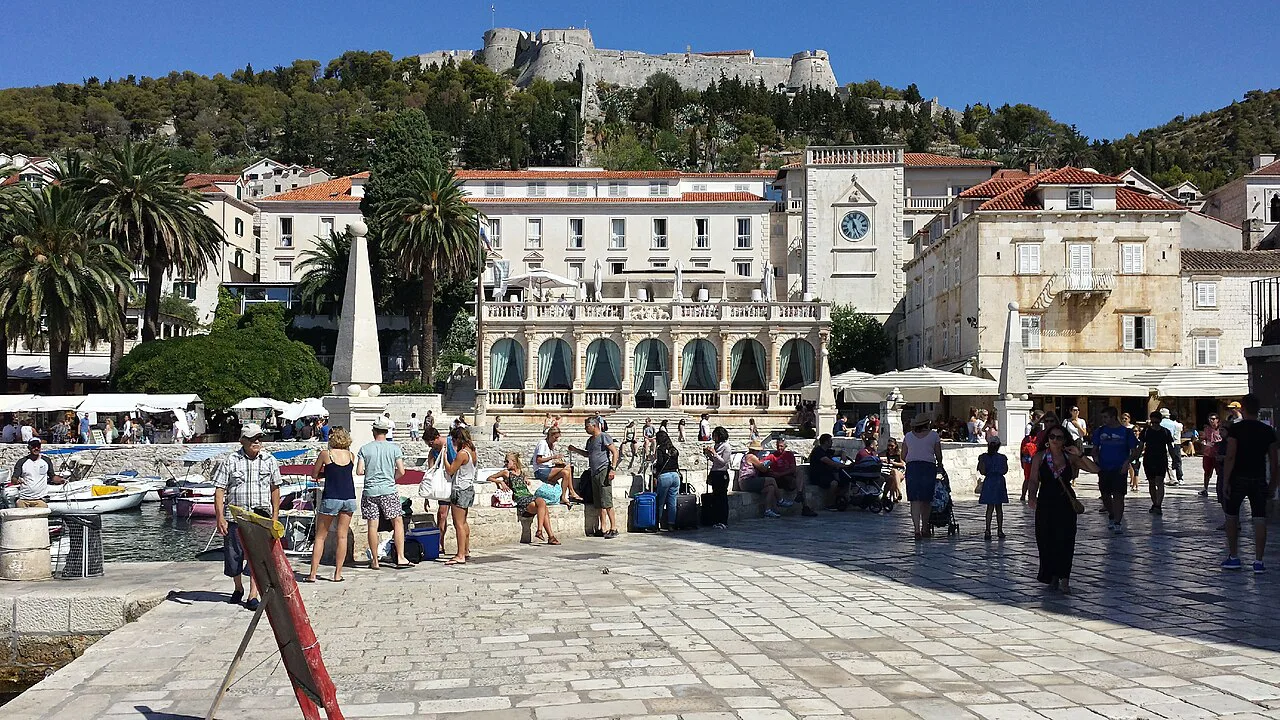
Pjaca sits in the island capital, Hvar town, where the harbour meets the old town, so anyone arriving by boat walks into it within minutes. From the Riva, the waterfront promenade, follow the quay east and the square opens to your right, with the cathedral closing the far end. Catamaran passengers arriving at Hvar port take the same short walk; those landing at the car-ferry terminal in Stari Grad are on the other side of the island and need a bus or taxi across, as Time Out's Hvar guide sets out.
Because the square has the sea on one side and the old fortified town rising on the other, it works as a natural orientation point. Fix the cathedral as your eastern marker and the harbour as your western one, and the lanes running north into Groda become easy to navigate without a map.
What you see standing on the square
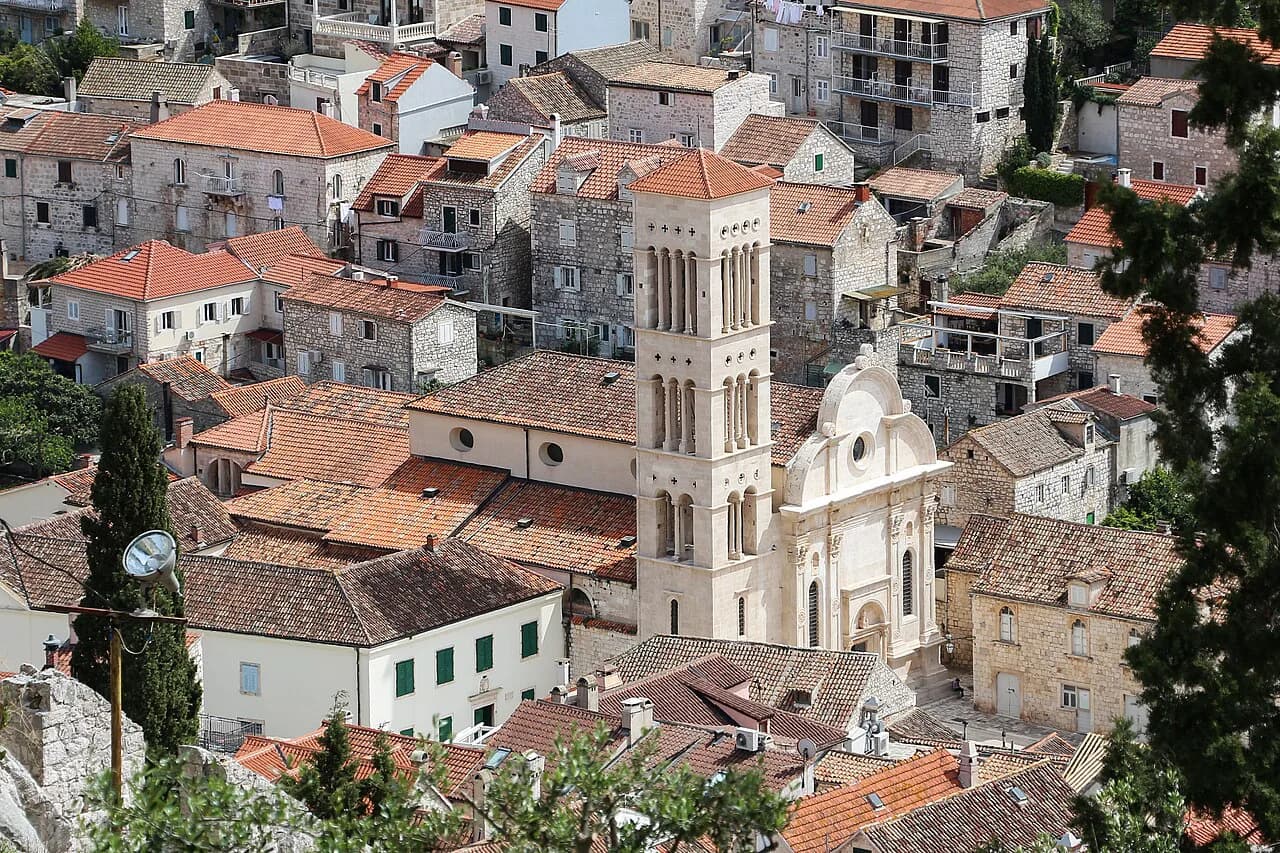
At the east end stands St Stephen's Cathedral, built between the 16th and 18th centuries as a triple-naved basilica with a late Renaissance trefoil facade symbolising the Holy Trinity. Opening times and any entry charge are set by the cathedral authorities, so check them at the door or on the parish noticeboard before you plan around a visit.
The City Lodge was first mentioned in 1289, rebuilt from the 15th into the 16th century, and given its final facade at the beginning of the 17th century, when the Venetians used it as a public courthouse and a venue for public auctions of taxes and customs duties. The Hvar Arsenal and the theatre above it sit in the same run of buildings, making a short architectural circuit of the square's edge.
The Hvar Clock Tower is part of the same group of civic buildings on and around Pjaca. It is brief to see from outside, but it completes the set that gives the square its character, alongside the cathedral and the well.
Around the edges: the nunnery and the lanes of Groda
A short walk from the square, the Benedictine nunnery has occupied its site since 1664 in what was originally the family complex of the poet Hanibal Lucić. The nuns have made lace from agave threads since the 19th century, and that craft is inscribed on the UNESCO list of intangible cultural heritage. Visits to the convent collection depend on the community's arrangements, so it is worth asking at the door what is open that day.
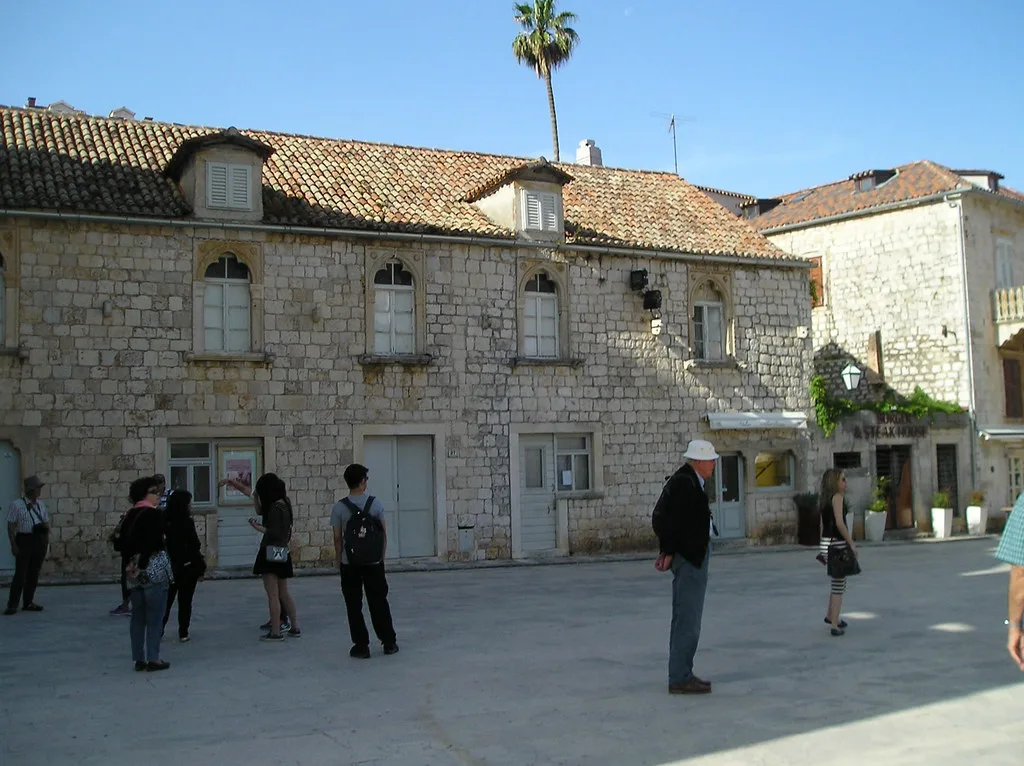
North of the square, the alleys known collectively as Groda climb into the old town; Time Out places Hvar town's restaurant alleys in exactly this quarter north of the main square. They are narrow, stepped and shaded for much of the day, and they are the quickest walking route toward the upper town rather than a destination in themselves.
Looking up at the City Fortress (Fortica)
The City Fortress, Fortica, rises above the town and relates directly to the square below: walls and fortress together formed one defensive system, and the population took refuge inside during the invasion of 1571. Construction on the site began after 1278 under Venetian rule, a replacement fortress went up in 1551, and the baroque bastions were added in the early 17th century after a gunpowder explosion in 1579 caused serious damage.
You can see the fortifications from the square, but reaching them means a climb through the old town, so treat it as a separate outing with its own time budget. The Hvar city walls en route are part of the same story and worth a pause on the way up.
How long to allow
Budget 15 to 20 minutes for the square itself: enough to walk its length, read the well and the paving, and look at the cathedral facade and the City Lodge. That is the honest minimum, because there is no ticket and no queue to slow you down.
Add 30 to 45 minutes if you go inside the cathedral, and rather more if you also take in the nearby Franciscan monastery, reached by a short taxi-boat ride from Hvar town according to Time Out, where a cloister and a garden offer shade off the open stone. Add roughly an hour more if you climb to the fortress, since the ascent through the stepped lanes is steady rather than gruelling.
When to come
Hvar has drawn organised tourism since 1868, when the tourist board notes it began on the island, and Pjaca sits at the centre of that. Outside the high season the same stone and architecture are there with far fewer people; check the current season's opening arrangements for the buildings you most want to see before you build a day around them.
Shoulder-season visits give you the same stone and architecture with far fewer people, at the cost of a thinner choice of what is open on any given day. If your trip depends on seeing a specific interior, fix that building's hours first and build the rest of the day around it.
Nearby sights within a few minutes
Hanibal Lucić's summer residence, built in the middle of the 16th century near the old road that once linked Hvar and Stari Grad, now houses the Hvar Heritage Museum. The building keeps a Renaissance garden and paired houses, one for the family's country use and one for working purposes. Check the museum's current opening days before walking out, as it sits slightly away from the square.
Time Out describes the Franciscan Monastery, Hvar, as a distinctive island retreat reached by taxi-boat from Hvar town, so it works as a separate short excursion rather than a step off Pjaca. Pair it with the civic buildings on the square across a half-day instead of trying to fold both into one walk.
Practical points
The square itself needs no ticket and has no gate, so you can walk through it at any hour. The buildings around it are separate: opening days and any charges for the cathedral, the nunnery collection and the fortress are set individually, so check current details locally or on the Hvar tourist board site before you commit a morning to one of them.
Wear shoes with grip, as the paving and the stepped lanes around the square are polished smooth by foot traffic and slippery when wet. Carry water in July and August, when the open stone holds heat through the afternoon.
Is Pjaca worth more than a photo stop?
Yes, if you use it as a starting point rather than a backdrop. Cross the square once for orientation, then pick one interior, either the cathedral or the Benedictine collection, and one climb to the fortress, and you will have spent a solid half-day on Hvar's history rather than ten minutes on its paving.
Explore more Hvar guides
Frequently Asked Questions
Do you need tickets to visit Hvar main square?
No. Trg svetog Stjepana is an open public square with no gate or admission charge, and you can walk through it at any hour. The cathedral, the nunnery collection and the fortress above the town are separate buildings, so ask locally about their current opening days and any charges before planning around them.
How do you walk to Pjaca from the Hvar ferry and catamaran arrival points?
From the harbour in Hvar town, follow the Riva east and the square opens off the waterfront within a few minutes on foot. Arrivals at the car-ferry terminal in Stari Grad are on the other side of the island and need a bus or taxi across before you reach Hvar town.
What is the best time of day to see the square without crowds?
Early morning is quietest, with the bonus of softer light on the cathedral facade. High-season afternoons are the busiest, when the yacht harbour and summer day-trippers overlap; shoulder-season visits trade a thinner choice of open interiors for far fewer people.