
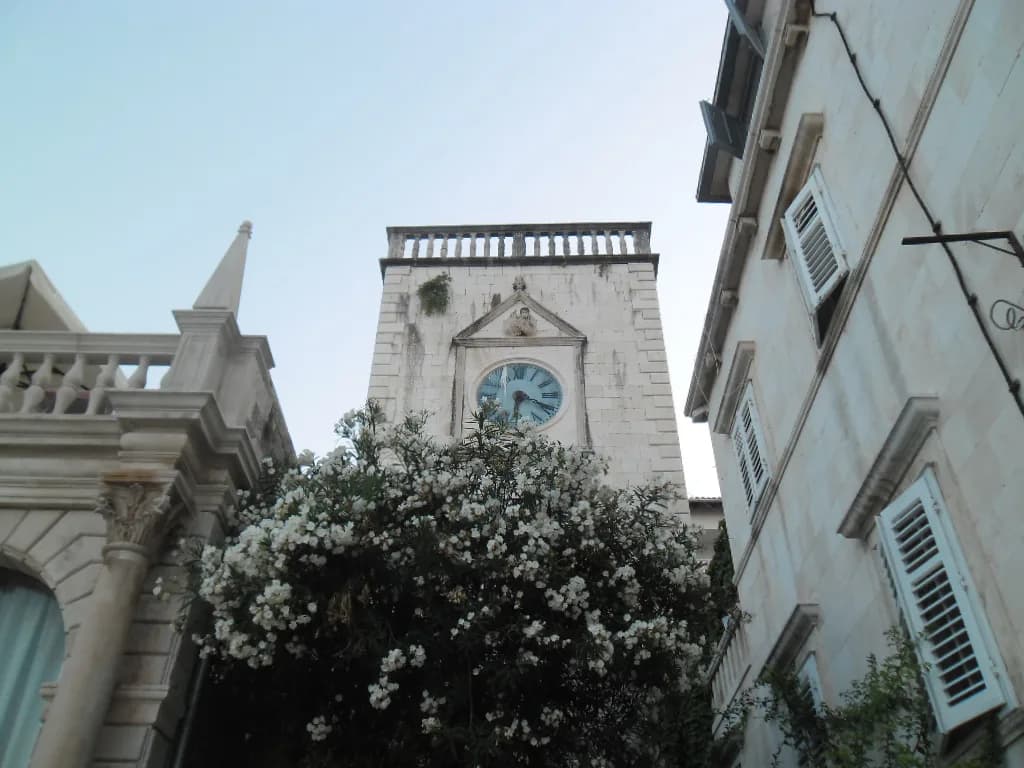
Hvar Clock Tower (Leroj): Where It Is and What You See

The Hvar clock tower is a ten-minute stop, not an hour-long attraction: it rises on the edge of Pjaca, the town's main square, close to the arcaded Loggia. Locals call it the Leroj, and it began as part of the town's defensive walls and as part of the Governor's Palace. This guide pins down where it stands, what you see, and what sits within a minute's walk, with the rest of the town in Hvar Attractions: 11 Visitor Guides.
The palace the tower belonged to was demolished at the end of the 19th century, so what remains on the square is the tower and the Loggia beside it. Treat it as part of the Pjaca ensemble rather than a separate sight with its own interior to explore.
What the Hvar clock tower is and why it is called the Leroj
The Leroj is the name to use if you ask for directions, and it refers to the clock tower that originally formed part of the town's defensive walls. It also belonged to the Governor's Palace, which stood on the square. The structure's interest lies in that double identity as fortification and civic building rather than in the clock face alone.
Because the palace was demolished at the end of the 19th century, the tower now reads as a standalone landmark rather than the gateway to a grand residence. What you see from Pjaca — the stone tower and the Loggia below — is essentially what there is; plan for a look, not an interior visit.
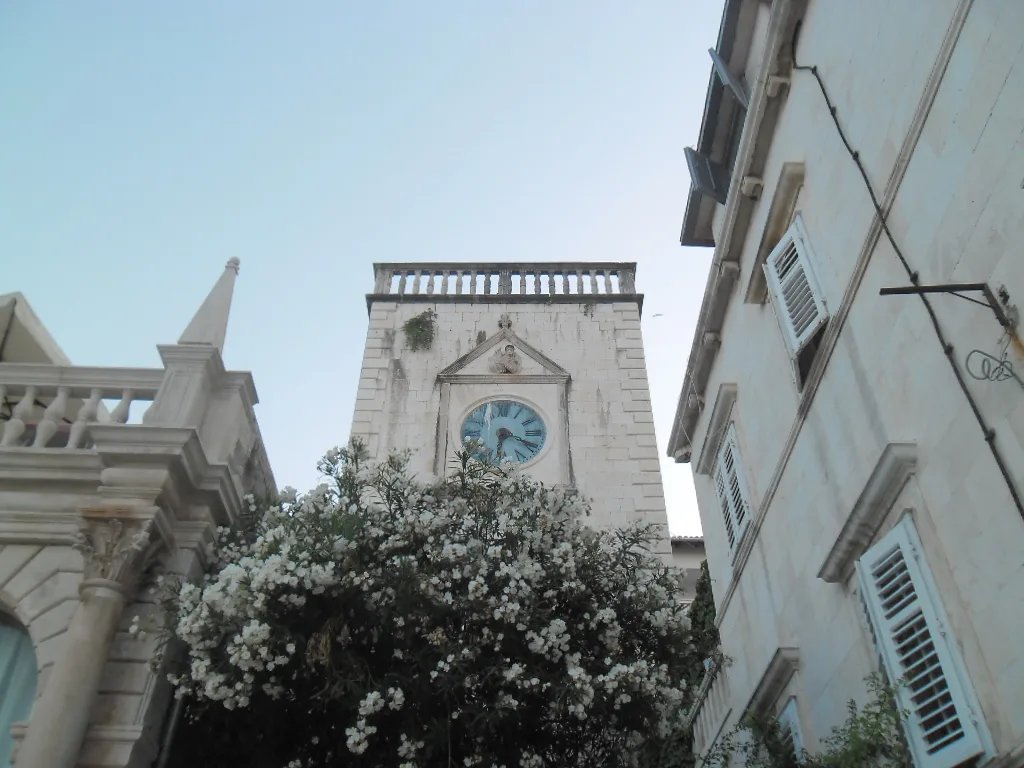

Where it stands: on Pjaca, beside the Loggia
The tower stands on Pjaca, the square the tourist board describes as the largest in Dalmatia, spreading over 4,500 square metres. The Loggia alongside it was used as a public courthouse under Venetian rule, with the cathedral immediately at hand. Look from the open middle of the square towards the Loggia for the cleanest view of the group. Our guide to the main square covers the whole of Pjaca.
Pjaca began as a deep cove filled with rock over centuries, and it was fully paved in 1780.
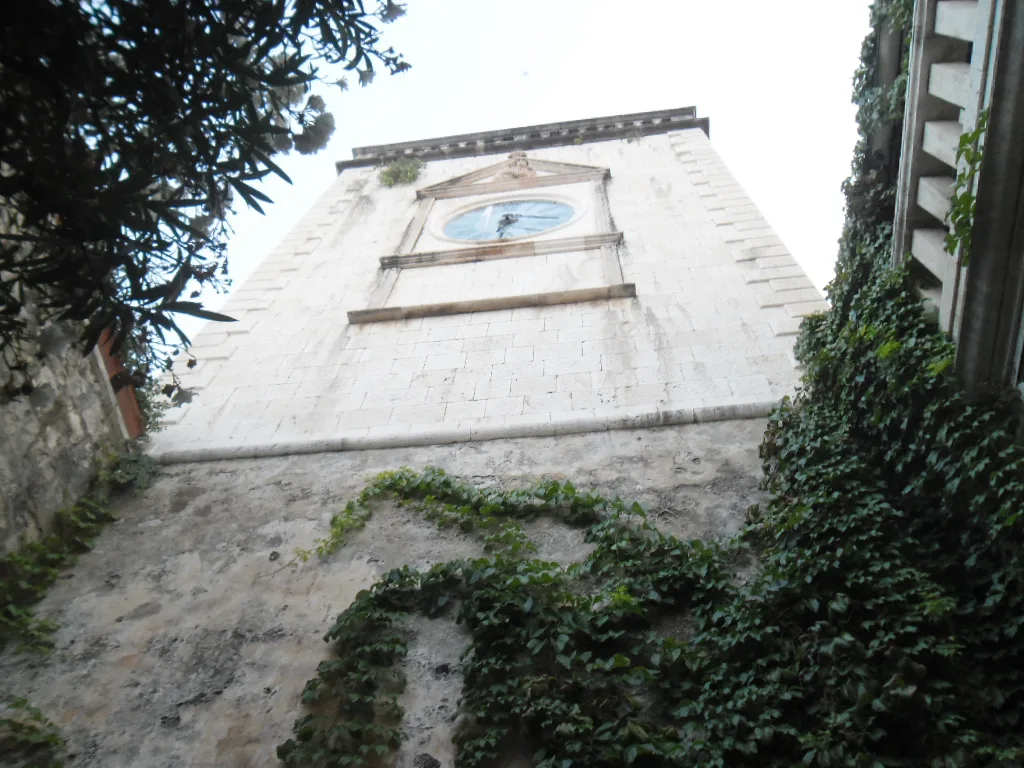

What you actually see: the tower, the clock face and the Loggia below
From the square you see the stone tower rising above the open arches of the Loggia. The Loggia itself was first mentioned in 1289, built through the 15th and 16th centuries, damaged during the Ottoman attack of 1571 and given its final facade in the early 17th century. It later housed a cafe, a reading room and a ballroom, before the neighbouring Duke's Palace was pulled down at the beginning of the 20th century for the Empress Elisabeth's hotel.
Set aside any expectation of a clock-face close-up: the tower is best seen from ground level across the square. In high season people cross the frame constantly, so it is a composition to work around rather than a quiet monument.
Its history in brief: town walls and a lost palace
The tower's history runs through the town's defences rather than a single building campaign: it was part of Hvar's walls and of the Governor's Palace, which was demolished at the end of the 19th century. Fortification first, civic palace second, lone landmark today.
The tourist board describes the town's defences as a single system, with the fortress above built in 1551 on the site of an older one and repaired after a gunpowder explosion in 1579. If the tower leaves you wanting more stonework, the walls explain the enclosure around the square, and Hvar Fortress (Fortica) takes you into the same system.
How to reach it on foot from the harbour and the Riva
Arriving by catamaran or ferry, you land at the harbour on the town's edge and walk inland with the water behind you until the square opens in front of you. The tower and Loggia are across Pjaca from the harbour side, so you cross the square to reach them; the last stretch into town is on foot either way.
How long to allow, and the best time of day
Give the tower ten minutes on its own, or fold it into a 30- to 45-minute circuit of Pjaca with the cathedral, the Loggia and the Arsenal. The square is the busiest place in town when crowds are in, and the lanes past the Loggia fill in waves; early morning and late afternoon are calmer and better for photographs.
If it is crowded, the lanes behind the cathedral give you breathing room before you return to the square.
What is within a minute or two
The Loggia, the cathedral and the Arsenal all sit within a minute of the tower, which makes Pjaca the most efficient short stop in town. The Arsenal was built in 1579 on the site of a 13th-century building as a storage and service facility for Venetian ships, and it now holds the Gallery of Modern Art in the lobby of the historic theatre, the oldest communal theatre in Europe. Our Hvar Arsenal guide covers the building and the theatre.
The cathedral treasury, kept in the Bishop's Palace, holds Gothic, Renaissance and Baroque works, including a silver bust of St Prosperus and the cloak of the last Venetian doge reworked into a pluvial. It is a proper museum visit rather than a glance, so give it its own slot and confirm current opening hours before you go.
A few steps off the square, the Benedictine nunnery keeps its lace made from agave threads, a craft inscribed on UNESCO's intangible heritage list and made by the nuns since the 19th century. The Franciscan monastery holds a Last Supper painting and a celebrated courtyard cypress. The guide to Franciscan Monastery, Hvar covers the collection and the cloister.
Nearby steps up to the Fortica and the view back over the tower
The natural next move from the Loggia is the climb to the Fortica, the fortress on the hill above the northern part of town, roughly a hundred metres up. From the terrace you get the view back over the roofs and the tower.
The trade-off is heat and effort: the path is exposed for much of its length and unpleasant in the middle of a summer day. Go early or late and carry water; the fortress held out in the 1571 Ottoman attack, which makes sense of the walls and tower you have just seen.
Practical points: what needs a ticket and what does not
The tower is viewed from a public square rather than entered, and the heritage record describes it purely as a surviving structure rather than a museum with a door, so plan on seeing it from outside. Anything with a door on Pjaca, including the cathedral treasury and the gallery in the Arsenal, is a separate visit with its own arrangements; ask at the tourist office on Pjaca for current hours and admission, which change by season.
Is the Leroj worth seeking out?
Yes, but as a two-minute pause on Pjaca rather than a destination in its own right. The tower's value is in what surrounds it: the Loggia beneath, the cathedral beside it and the square that has been the town's living room for centuries. Go expecting an exterior, and you will enjoy it for what it is.
Build the visit in this order: cross from the Riva onto Pjaca, find the Loggia arches, look up at the tower, then choose between the cathedral treasury and the climb to the Fortica.
Explore more Hvar guides
Frequently Asked Questions
Where is the Hvar clock tower?
It stands on Pjaca, Hvar Town's main square, beside the arcaded Loggia. Locals call it the Leroj, and it is reached on foot across the square from the harbour side.
Why is it called the Leroj?
Leroj is the local name for the clock tower, which originally formed part of the town's defensive walls and belonged to the Governor's Palace.
Can you go inside the tower?
No — the tower is viewed from the public square. What remains on the square is the tower and the Loggia beside it; the Governor's Palace it belonged to was demolished at the end of the 19th century.
How long do you need at the clock tower?
About ten minutes on its own, or 30 to 45 minutes folding it into a circuit of Pjaca with the cathedral, the Loggia and the Arsenal.
What is there to see nearby?
Within a minute or two are the Loggia, St Stephen's Cathedral and the Arsenal, which holds the Gallery of Modern Art in the lobby of the historic theatre. The cathedral treasury in the Bishop's Palace and the climb to the Fortica above town are further options.