
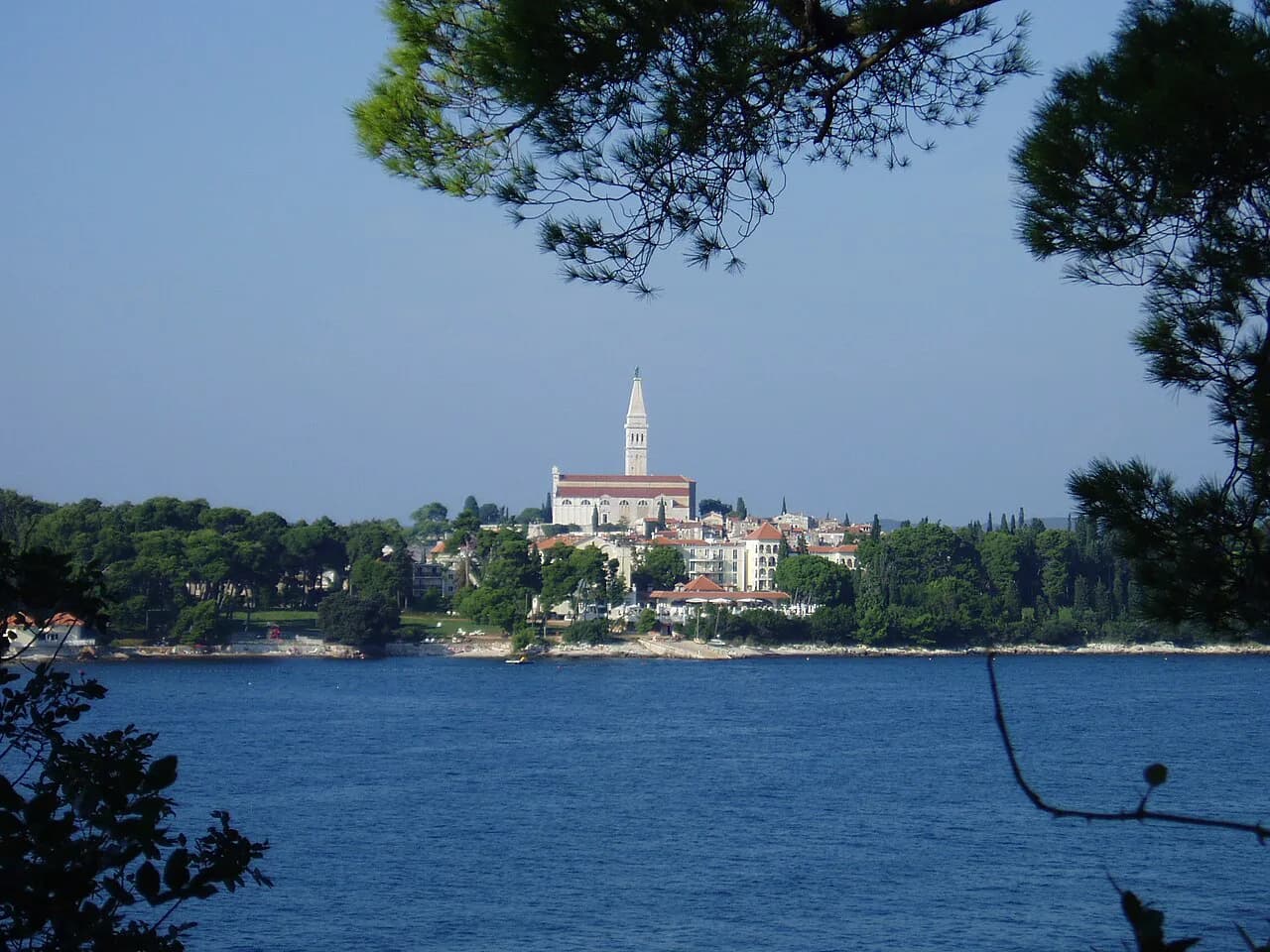
Punta Corrente (Zlatni Rt): Rovinj's Forest Park

Punta Corrente, better known locally as Zlatni rt or the Golden Cape, is the easiest half-day in nature you can make from Rovinj: a 52-hectare forest park with roughly 5 km of coastline that begins about 20 minutes' flat walk south of the old town and costs nothing to enter. The brief answer is to give it an afternoon, or a slow morning if you swim, and to go on foot rather than hunting for a parking space in July. This guide covers where the park sits, how to reach it, what grows and stands inside it, which coves suit which kind of swimmer, and how to judge whether it takes a half-day or most of a day.
What Punta Corrente is and where it sits
Zlatni rt shields Rovinj and its harbour from the south, running along the bays of Lone and Škaraba out to the capes of Montauro and Punta Corrente. The park covers 52 hectares, with about 5 km of coastline, 12.5 hectares of beaches and 800 metres of old drystone wall on the landward side. Think of it as one clearly bounded place rather than a stretch of town seafront: you enter at the north edge near Lone Bay, follow a coastal path south, and turn back at the tip.
Entry is free, which makes it the obvious counterweight to Rovinj's ticketed sights. If you are staying in the old town, an afternoon under the pines is easy to fit in after a morning of sightseeing, and the two halves of the day need no car at all.

How to get there on foot
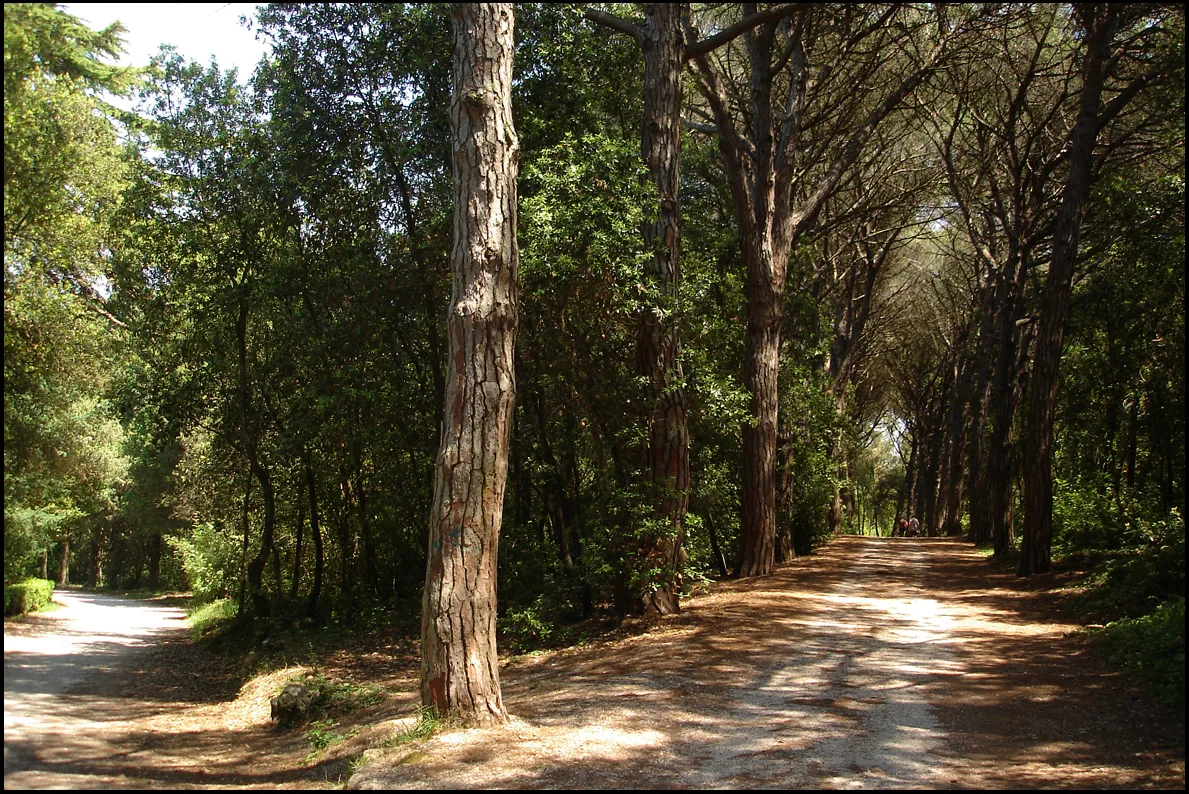
From the old town, walk south along the waterfront and the park begins just after Lone Bay; the path stays flat the whole way. Allow roughly 20 minutes from the town centre to the first trees. Because the route is level and shaded in parts, it works equally well as a stroll after the town's morning crowds or a brisk walk to catch late sun at the southern tip.

Getting there by car or by bike
Drivers park at the Škaraba or Lone Bay lots on the north edge of the park. Those lots fill by mid-morning in July and August, so arriving early is a real constraint in high summer rather than a polite suggestion. The harbour side is the place to look for bike hire, with rental shops on Obala Palih Boraca hiring hybrids and e-bikes by the hour or by the day. Ask at the counter what the current rate is before you take a bike out, since rates vary by season and outfit.
What to see: the cedars, the pine paths and the meadows
In 1890 the Trieste-born industrialist Georg Hütterott began buying plots in Lone Bay and on the Montauro and Punta Corrente capes, planting them up over the following years as something between an English landscape park and an arboretum. He brought in Himalayan cedars, Douglas firs, ginkgo biloba and rare trees from Mexico, America and Japan, and the row of Himalayan cedars arranged as a six-pointed star in front of the Punta Corrente meadow is still the park's signature sight. It was protected in 1948 and designated a forest park in 1961, a status it still holds.
The canopy is mostly native holm oak, which is what keeps the paths cool in August, with flowering ash and Mediterranean shrubs such as strawberry tree, bay laurel and myrtle underneath. Wide shaded promenades run the length of the coast, and narrower inner trails branch off into the pines towards small meadows used for picnics. The old stables from Hütterott's era, now a café, and a small guardian's cabin are the only built remnants of that period still on the peninsula.
Look out for roe deer, hare and pheasant in the deeper forest, and for the picnic tables and benches scattered through the meadows, which are first-come with no booking. There is a children's playground and an outdoor fitness station along the park if you are travelling with family or want a workout with a sea view.
Swimming from the limestone coast
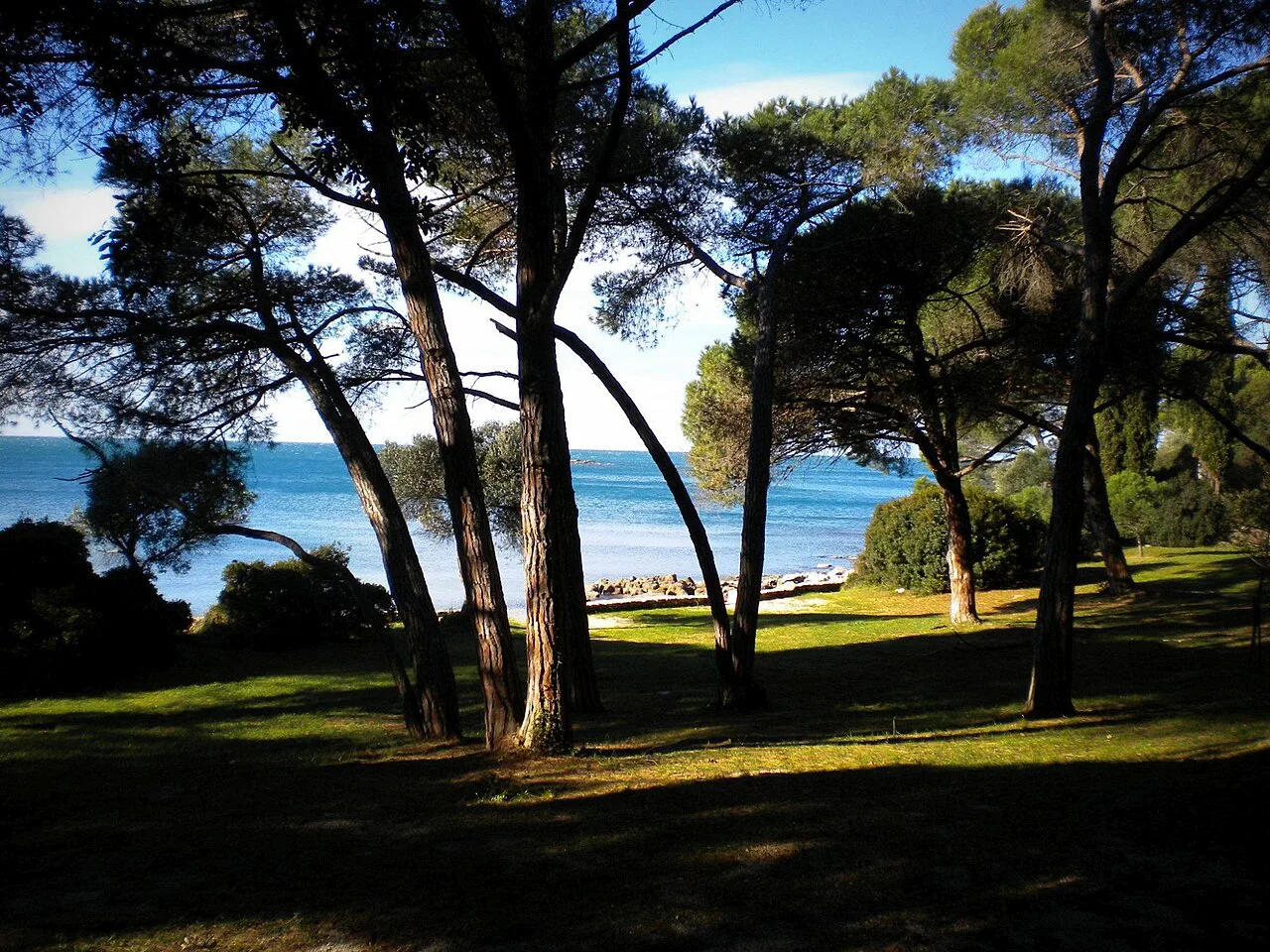
There is no sand here: the coast is flat limestone shelving and small rocky coves, with entry by ladder or a careful scramble down the rock. Water clarity is the compensation, clear enough to see your feet a few metres down. Bring water shoes if you have soft feet, and water and snacks regardless, since the few beach bars along the coast are a convenience rather than a full lunch.
Each stretch of the park suits a different swim. Lone Bay comes first walking from town, pebbly and busier because of the nearby hotel; Škaraba just beyond it has stone shelves and deep water straight off the edge, a favourite for an early dip; Cape Montauro is a run of dozens of small coves where you can walk until you find an empty one; and the southern tip past the cedar grove is quieter and better placed for sunset.
Walking, cycling and how long to allow
The main coastal path is wide, flat and largely shaded, which makes it good for a slow cycle as well as a walk; you can loop the whole park in under an hour on a bike. On foot, a straight out-and-back with a swim at Montauro takes a half-day at an easy pace. Give it a full day if you plan to swim twice, picnic in one of the meadows and walk down to the southern capes, and keep an eye on the sun since the exposed limestone gets hot by early afternoon.
The quarried cliffs at Cape Montauro
The shore side of Cape Montauro is a long line of cut cliff: hundreds of metres of pale vertical wall quarried over centuries to build Venice and the towns across the lagoon. Today climbers use it, and you will see bolts and sometimes a rope team on the rock. It is also one of the park's better photo stops, especially in low evening light.
When to go
High summer gives you the deepest shade and the warmest sea, but the car parks at Škaraba and Lone Bay fill by mid-morning in July and August, and the first coves near Lone Bay get busy. Walking in from town sidesteps the parking problem entirely. Shoulder-season mornings are quieter and comfortable for the full length of the coastal path, while the holm oak canopy keeps the middle of a summer day bearable.
In the old town nearby, the Church of St Euphemia and the walk up Grisia Street are best done early before the day's heat and crowds build, with the park a natural late-afternoon follow-on.
Nearby: Cuvi, Villas Rubin and the Lim Fjord
From the park's south end you can keep going along the coast to Cuvi and Villas Rubin. The Lim Fjord lies about 15 km further one way, which is a trip in its own right rather than a stroll from the park. That onward stretch is what decides how much of your day the park uses: a loop back to town leaves the afternoon free, while continuing along the coast turns Punta Corrente into the first leg of a full day out.
Is Punta Corrente worth a half-day?
Yes, if you want sea, shade and a flat walk without paying an entrance fee or booking anything. It suits swimmers who do not mind ladders and rock, cyclists wanting an easy loop, and anyone with an afternoon spare after the old town. Skip it if you need sand under your feet or a full-service beach. Check current details for bike hire rates and any café opening times before you set out.
Explore more Rovinj guides
Frequently Asked Questions
Is Punta Corrente free to enter?
Yes. The park is open to visitors at no charge, with no ticket needed for the paths, coves or picnic areas.
Can you cycle through Punta Corrente?
Yes. The main coastal path is wide, flat and shaded, and the whole park loops in under an hour by bike. Bike hire is available near the harbour on Obala Palih Boraca; check current rates at the counter.
Are there cafés or restaurants in Punta Corrente?
There is a café at the park entrance, and a few beach bars along the coast for drinks. For a proper meal, bring your own picnic or eat back in Rovinj.
Do you need a map of Punta Corrente?
The layout is simple: enter at the north edge past Lone Bay and follow the coastal path south to the capes, with inner trails branching off into the pines. A phone map is enough to keep your bearings.