
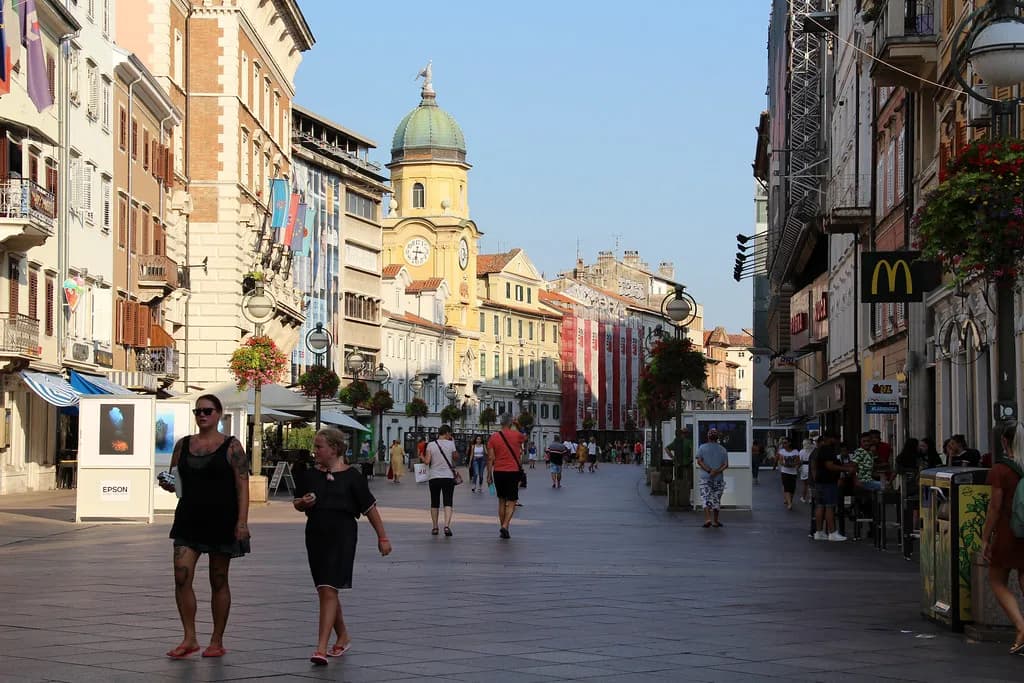
Korzo, Rijeka: what to see on the city's main promenade
Korzo is Rijeka's main pedestrian street and its longest car-free zone, a broad promenade through the city centre that you walk for the atmosphere rather than for a single sight. There is no ticket, no gate and no opening time: you join it from the surrounding centre and follow it. This guide covers where the Korzo runs, what to look for along its facades and fountains, what the souvenir shops sell, and how to fit it into a wider look at the city.
Treat it as a spine rather than a destination. Landmarks such as Trsat Castle sit up the hill above the city, while the Rijeka tunnel cuts through the ridge beneath it, so a walk on the Korzo slots naturally between the two. Half a day in the centre covers the street comfortably without rushing.
What the Korzo is
The Korzo is Rijeka's pedestrian main street and the city's longest foot-only zone, running as a promenade through the centre rather than a single square. Locals treat it as the place where the city is expressed and reflected, and it doubles as the everyday shopping and meeting street. For a visitor, that means it is not a monument you queue for but a route you walk, and the interest lies in the facades, the street furniture and the life on it.
It is also the most relaxed way to get oriented in a city whose centre is compact and whose sights sit at different levels. You can use the street as a fixed line to return to after climbing to a viewpoint or diving into a museum. Nothing on the Korzo itself requires planning ahead.

Where the Korzo is and how to find it
The Korzo runs through the centre of Rijeka, in the Primorje-Gorski Kotar county on the northern Croatian coast, in the city spread around the mouth of the Rječina. Its address is listed as Korzo, 51000 Rijeka, and it is reachable on foot from the surrounding centre streets. Head for the pedestrian core and you will meet it rather than approach it from a single entrance.
A practical anchor is the city tourist information centre at Korzo 14, in the heart of the promenade, where you can pick up a map and ask about current exhibitions and transport. It is the one address on the street worth noting down before you set off.

Walking the promenade: what to expect on foot
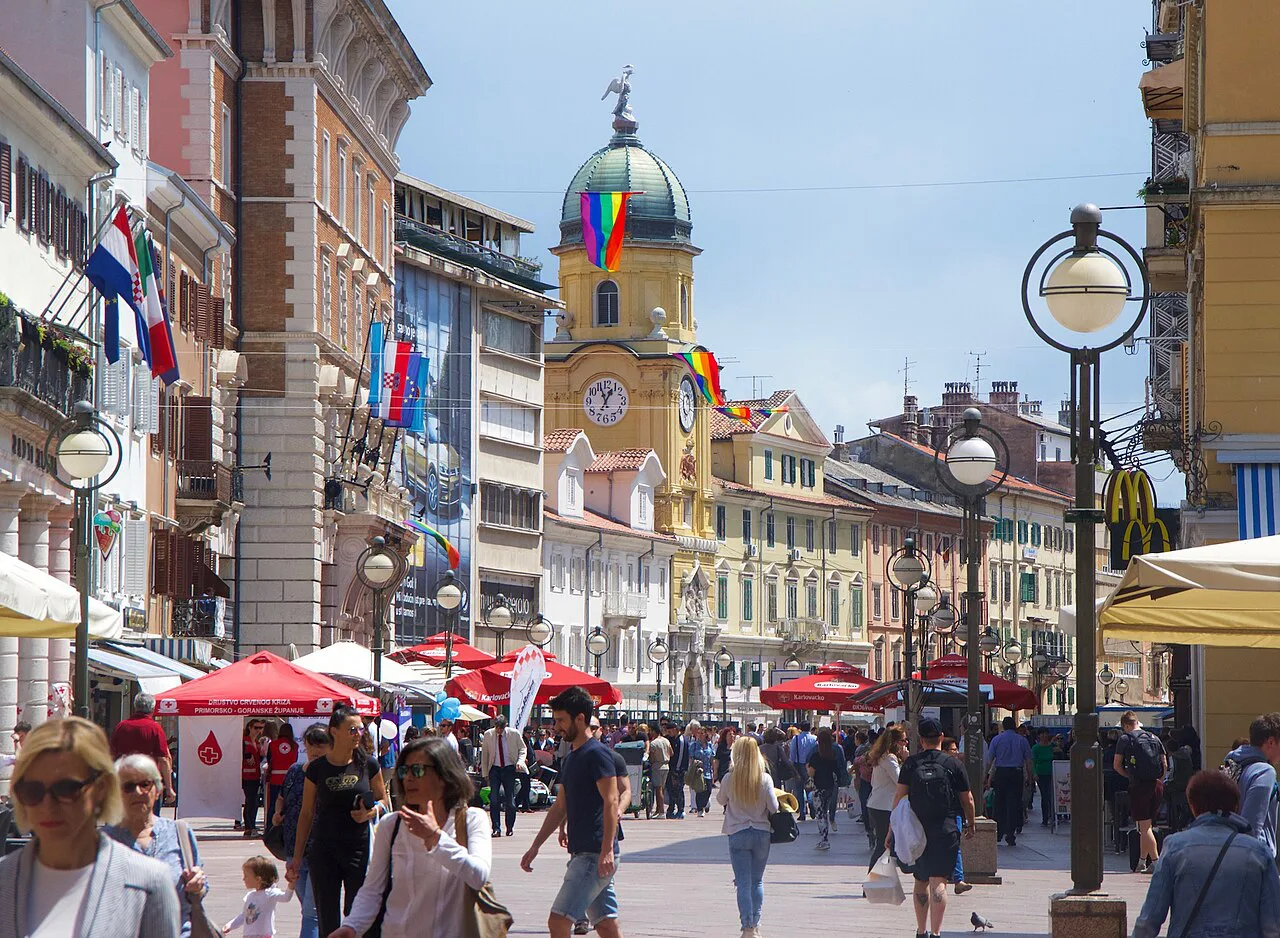
Because the Korzo is pedestrian, a walk here is mostly about pace: you cross it in one direction in a matter of minutes if you are going somewhere, or stretch it to an hour if you stop at terraces, benches and shop windows. Approach from the side streets rather than expecting a grand entrance, and let the promenade pull you along.
The street connects easily with the rest of the centre. The Rijeka tunnel gives a direct route through the ridge towards Trsat when you want to combine the promenade with the hill above, and the old town is a short walk from the central stretch.
The architecture: four styles in one street
The Korzo's facades are its real exhibition. The street began to take the form you see today from the early 19th century, as the main promenade and meeting place for Rijeka's residents and a testing ground for representative palaces in successive styles: classicism, historicism, Secession and modernism. Reading the fronts of the buildings as you walk is the single best reason to go slowly, and you can trace the sequence above the shopfronts without any guidebook.
What makes the street unusual is what lies under it. Until the ditches were covered and the town walls demolished in the second half of the 18th century, this was a stony shoreline with a few wooden piers, warehouses, shipyards and the city Loggia where grain, fish and salt were traded. The elegant promenade sits on land later built out over the sea, which is why the whole composition feels like a stage set rather than a medieval street.
Landmarks along the way: clock, fountains and benches
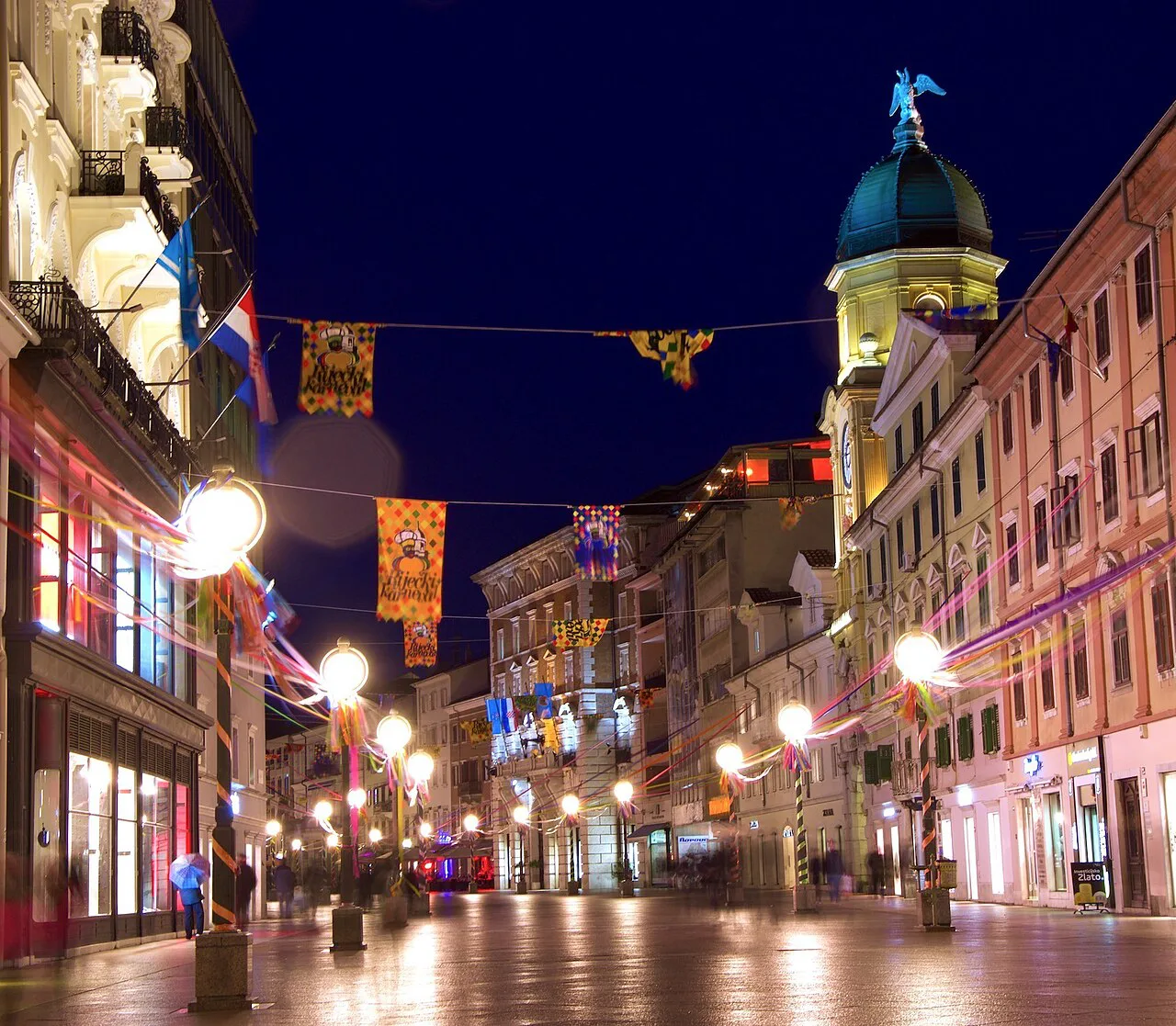
Along the Korzo you will pass fountains and a clock that keeps watch over the promenade, together with benches placed specifically for people to sit and watch the street go by. These are the small fixed points that help you navigate: use the clock as a meeting place, and the benches as a place to pause. The upper floors of the surrounding buildings are themselves a popular vantage point for looking down on the street.
The old town, the cathedral and the Rijeka clock tower are among the sights you can pair with a Korzo walk in the centre, and the Governor's palace and the Molo Longo breakwater are also part of the compact centre. The Korzo works as the connective tissue between them.
Shopping and souvenirs: Morčić and Torpedo
The Korzo carries a rich run of souvenir shops, and two Rijeka-specific buys stand out: the Morčić pendant and the Torpedo ballpoint pen. The Morčić is a blackamoor figure traditionally worn as jewellery, and the Torpedo pen nods to the city's torpedo works, so both make more meaningful keepsakes than generic Adriatic trinkets. Buy them here rather than at a coastal stall elsewhere.
Cafés, bars and restaurants line the promenade in quantity, which makes it easy to stop mid-walk without leaving the street. Beyond that, browsing windows along the same stretch covers everything from everyday shops to souvenir counters.
Terraces and the rhythm of the street
The Korzo has a daily rhythm worth catching. The morning belongs to coffee on the terraces, the middle of the day to shopping and errands, and the evening to a livelier, younger mood as cafés fill and the street stays wide awake while the outer city goes quiet. A coffee on one of the many terraces is the standard way locals take the street's temperature.
If you only have an hour, walk the length of the promenade first and then sit somewhere with a view of it; if you have longer, come back in the evening for the change of mood.
The bura wind and the walk
The bura, the gusty north-easterly wind that marks Rijeka as much as the Korzo itself, is part of life on this promenade. Locals use the street in winter coats, in summer dresses, with umbrellas, and even when the bura tugs at them. On a windy day expect the terraces to be less inviting and dress for the wind rather than for the forecast; the walk itself stays open and free.
How long to allow and what to combine nearby
Allow about an hour for the Korzo itself with a coffee stop, or half a day if you use it as the base for the centre. Combine it with the old town around the Rijeka clock tower and the cathedral, then climb or tunnel up to Trsat Castle for the view back over the city and the coast. The museum of modern and Contemporary art Rijeka and the natural history museum Rijeka add a cultural half-day when the weather turns.
A simple sequence works well: start at Korzo 14 for a map, walk the promenade, cut into the old town, then go up to Trsat Castle and come back down for an evening on the terraces. If you have a clear night, the astronomical centre Rijeka makes a different kind of ending to the day.
Should you build your Rijeka day around the Korzo?
Yes, but as a line through the day rather than a sight in itself. The Korzo is free, always open and the easiest place to start in Rijeka, and its facades, clock, fountains and souvenir shops reward a slow hour. Use it to link the old town, the museums and the climb to Trsat Castle, and let it be where you return for coffee at the end.
Explore more Rijeka guides
Frequently Asked Questions
Do you need tickets to walk the Korzo in Rijeka?
No. The Korzo is a public pedestrian street, so there is no ticket, gate or opening time. You simply walk onto it from the surrounding centre streets, and the only money you might spend is on coffee, shopping or souvenirs along the way.
How do you reach the Korzo from Rijeka's centre?
Head for the pedestrian core of the city, and the Korzo meets you rather than starting at a single entrance. The tourist information centre at Korzo 14 sits on the promenade and makes a useful first stop for a map and local information.
Is the Korzo the same as the Riva in other Croatian towns?
In spirit, yes. Both are waterfront or central promenades where residents gather, but Rijeka's Korzo is a pedestrian shopping and café street running through the centre rather than a harbour-side quay, and it carries the city's historic facades along its length.
What souvenirs should you look for on the Korzo?
The two specifically Rijeka buys are the Morčić pendant and the Torpedo ballpoint pen, both sold in the souvenir shops along the street. They tie to the city's own traditions rather than to the Adriatic in general.