
Šubićevac, Šibenik: What the Hill District Above the Old Town Offers Visitors

Šubićevac is worth an afternoon rather than a day: it is the residential hill district of Šibenik whose real draw is the walk up to St John's Fortress and the view back over the old town, the sea and the islands. The district sits above the historic core, so you reach it on foot by climbing rather than by touring. This guide covers what the area is, how the fortress is laid out, where the stadium fits in, and how it compares with the lower quarters covered in the Sibenik Neighborhoods guide.
Plan the climb around the fortress opening hours rather than around the district itself, because there is little else here aimed at visitors. St John's Fortress opens daily from 9 AM to 5 PM, with last admission half an hour before closing, according to Tvrđava kulture Šibenik, the public institution that runs the fortresses. Those are the published hours and they shift with the season, so confirm the day before you set out.
What and where Šubićevac is
Šubićevac is one of the city districts, or gradske četvrti, that make up Šibenik, listed in the city's own register of districts beside Varoš, Meterize and the rest. It occupies the rising ground above the old town, which is why the fortress and the stadium both ended up here rather than down by the water. Treat it as a residential quarter with two big landmarks rather than a district built around tourism.
The practical consequence is that you will not find a strip of sights to work through, and no venue here is set up around visitors apart from the fortress itself. What you get is a climb, a fortress, a stadium and streets where people live. If you want the old town's lanes, cathedral and Riva, those belong to the lower districts.
Come with the right expectations and the district works well as a late-afternoon outing: climb, tour the fortress, watch the light change, then descend for the evening. Come expecting a district full of cafés and shops and you will be disappointed.

St John's Fortress and the walk up
St John's Fortress is the largest of Šibenik's three fortresses and the last to be renovated, with work finished in 2022. It was built in 1646 in just 58 days as the main point of the city's new defence system before an Ottoman attack, and the people of Šibenik built it with their own hands. That history is the reason to climb: you are walking into the piece of the city's defences that mattered most.
The fortress has two parts, and knowing them saves confusion at the gate. The star is the fortified southern section, and the pliers is an outer fortification to the north below which sits an educational campus. There is only one entrance and exit to the star, on its south side on the access road, and from that entrance the access road continues down to the pliers.
On site there is a bar at the top of the fortress, described as its star, and a souvenir shop in the former powder magazine next to it; both keep the fortress's opening hours. Sanitary facilities, including adapted ones, are available in both the star and the pliers. Dogs are allowed on a lead, and drones are banned across the Šibenik fortresses.
Go late in the day if you can. Tvrđava kulture Šibenik suggests the golden hour and the sunset from what is the highest of Šibenik's fortresses, looking over the city, the sea and the islands. A Second World War bunker, a German-built reinforced concrete position from the occupation, survives on the site and adds a different layer to the visit.
For the fortresses as a set, see the Sibenik Attractions hub before you commit your time. If you want a fortress as the start of a wider city walk, Tvrđava kulture Šibenik's own advice is to begin at St Michael's Fortress, the oldest inhabited part of the city, then descend through the old town towards the cathedral and the rest of the sights. That routing also works in reverse for Šubićevac: climb to St John's, then drop into the lanes below.

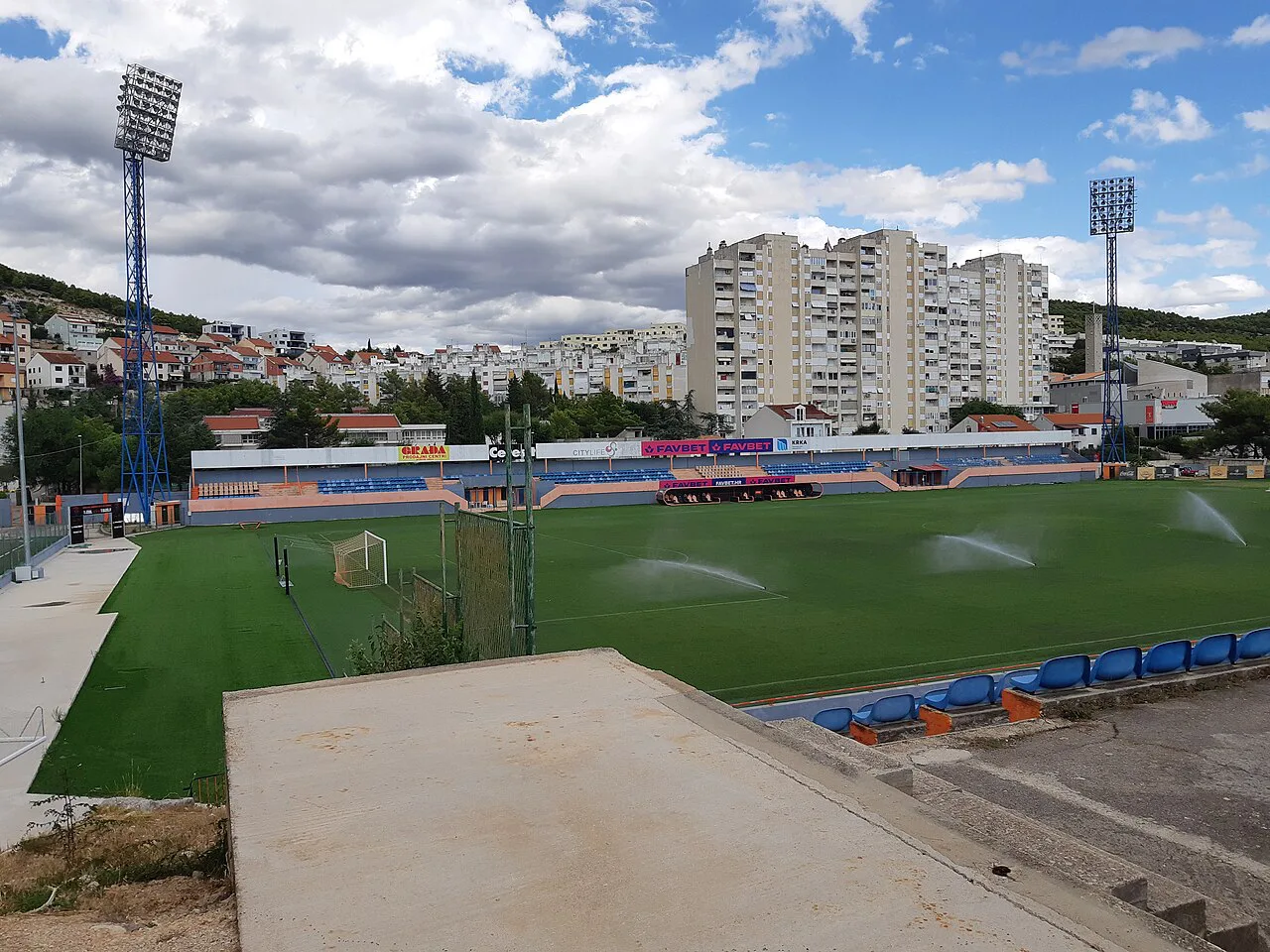
The stadium: Stadion Šubićevac
Stadion Šubićevac is the district's other landmark and the home ground of HNK Šibenik, the city's football club. It is a working stadium rather than a visitor attraction, so there is no reason to build a trip around it unless you are going to a match. Fixture dates, kick-off times and match tickets are not covered here; check the club's own channels if football is the point of your visit.
For everyone else the stadium is a wayfinding landmark on the climb, useful for orienting yourself as you head up towards the fortress. Its presence also explains the district's character: this is a part of Šibenik where people live and where the city plays, not a preserved tourist quarter.
Getting there and around on foot
Šubićevac is a walking district, and the climb from the old town is the normal approach; allow for steps and gradients rather than a gentle stroll. The fortress operator gives the nearest official city parking as Težačka Street and Put Gimnazije Road, both a short walk from the fortress walls.
There is no dedicated fortress car park. The nearest is the free lot beside the walls of Barone Fortress, open during Barone's opening hours, and there are further spaces on the north-east side on the slope towards Šubićevac. For anything beyond that, the city's official car parks are run by Gradski parking d.o.o. Šibenik, whose site lists locations and charges.
Once you are up, everything in the district is within walking distance, but the ground is uneven and the fortress itself is stone and steps. Anyone with mobility difficulties should look at St Michael's Fortress instead, where Tvrđava kulture Šibenik describes an access road from the fire station to a plateau and a lift to the underground level and the stage.
Tickets and timing for the fortresses
A single-fortress adult ticket is 11,50 €, students aged 7 to 18 pay 7,50 € and a family ticket is 28,00 €. The combined ticket covering all three fortresses costs 15,00 € for adults, 8,50 € for students and 33,00 € for a family. Payment is in euros only, by cash or card, and visitor insurance is included.
Two rules shape how you buy. The combined ticket, and the Barone and St John's ticket sold from March to November, can be used once within seven days of purchase, so you can split the forts across different days. Children under seven, ICOM members and visitors with disabilities plus a companion enter free, the last on production of a valid national or European document issued by the Agency for Commercial Activities.
Guided tours in Croatian and English are available for organised groups by appointment, at 20 € for St Michael's or Barone and 35 € for both. Audio guides, augmented-reality devices and other multimedia kit at the fortresses are free to use. Rates and seasonal hours change, so check the Fortress of Culture Šibenik site before you travel.
Who Šubićevac suits, and who it does not
Šubićevac suits travellers who want the fortress and the view without crowds, and who are happy to climb for them. It also suits anyone staying in the upper parts of the city who wants the old town within a downhill walk. The sunset from the highest fortress is the single best reason to come.
It does not suit anyone who needs level ground, a district full of shops and restaurants, or a day's worth of sightseeing within a few streets. Those travellers should base themselves lower down and treat Šubićevac as an excursion, with Dolac Sibenik the better fit for anyone who wants shops, the market and the ferry pier on the doorstep.
Is the climb to Šubićevac worth it?
Yes, for the fortress and the view, and for roughly half a day rather than a full one. The combined fortress ticket spreads the cost across three sites over a week, which makes the climb an easy addition to a Šibenik stay rather than a commitment.
Build the outing around a late-afternoon slot, check the fortress hours and rates for your dates, and treat the district as a residential hill with two landmarks rather than a sight in itself. Walk up, see the star and the pliers, stay for the light, and come down into the old town for the evening.
Frequently Asked Questions
How long does it take to visit Šubićevac and St John's Fortress?
Allow about half a day for the climb, the fortress and the views, including time at the bar and shop on site. The walk up from the old town adds steps and gradients, so build in more time if you stop often.
Do I need a car to reach Šubićevac?
No. The district is normally reached on foot from the old town, and the fortress has no dedicated car park. If you do drive, the nearest options are the free lot by the Barone Fortress walls and the official city spaces in Težačka Street and Put Gimnazije Road.
Can I use one ticket for several Šibenik fortresses?
Yes. The combined ticket covers all three fortresses and can be used once within seven days of purchase, so you can split your visits across different days. The Barone and St John's ticket is sold from March to November.